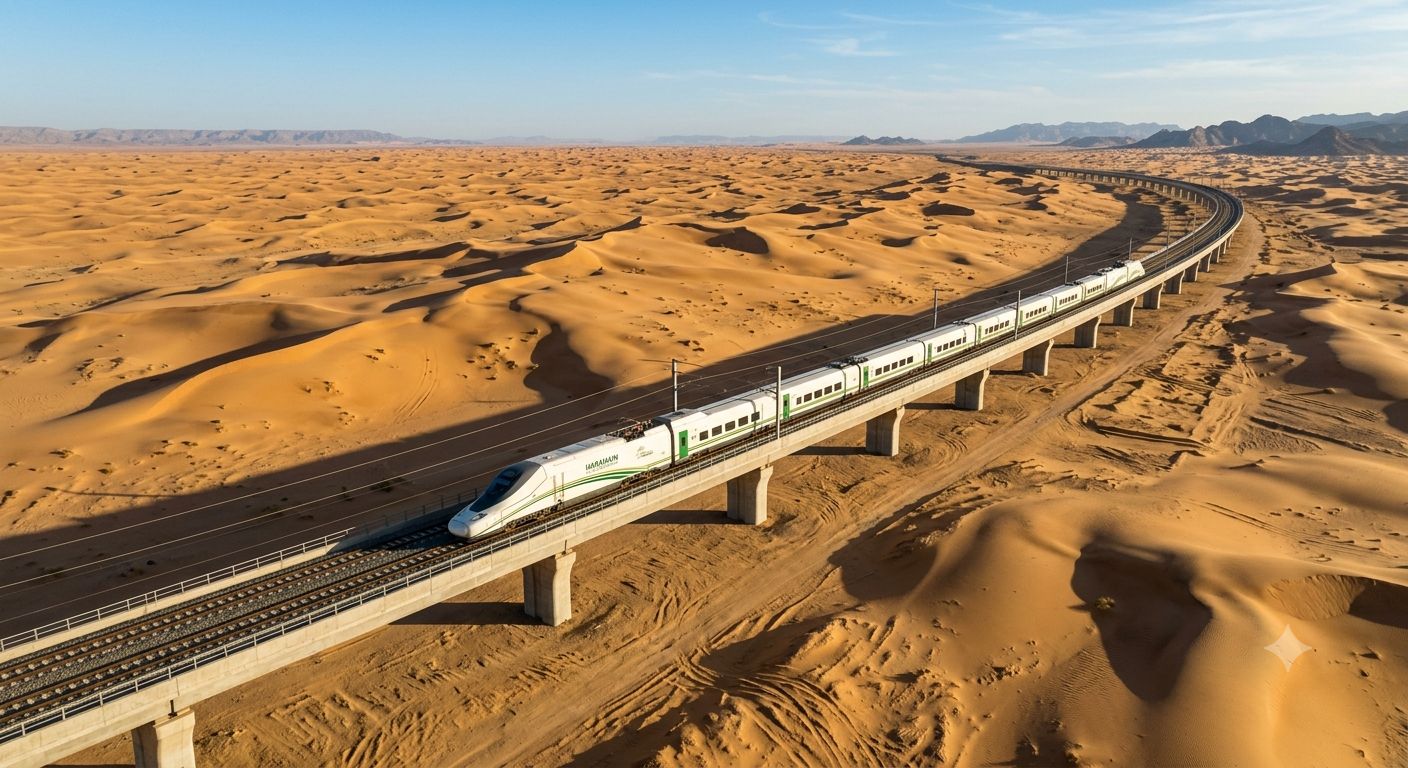
The journey between Makkah and Madinah is 447 kilometres. On the Haramain High Speed Railway, that becomes two hours and twenty minutes. By road it’s four to five hours. By bus, closer to six. By domestic flight — which practically speaking takes longer than driving once you work out the actual door-to-door time — even more. That maths problem comes later.
Most UK Umrah pilgrims make this journey once per trip, usually moving from Makkah to Madinah after completing Umrah to spend time at Masjid al-Nabawi. How you travel between the two cities matters more than people give it credit for. Arrive in Madinah having handled it well and you step into a relaxed itinerary. Arrive having got it wrong and you’re standing at a train station with four suitcases, a 25 kg limit you didn’t know about, and no hotel transfer arranged.
This guide covers all four options: the Haramain High Speed Railway, the Darb Alwatan intercity bus, private car, and the domestic flight that most people shouldn’t book. It also covers the things most comparison pages skip entirely: which bus company actually runs this route now (not SAPTCO, despite what half the travel blogs on the internet still say), why the train’s 25 kg luggage limit catches Makkah-to-Madinah travellers off guard, and what men travelling Madinah to Makkah by train need to do about Ihram before they board. If you’re still deciding when to travel, our guide on the best time to perform Umrah is worth reading first — peak seasons affect which options are available, how early you need to book, and what the train journey looks like when 48,000 people are using it in a single day.
All Four Options at a Glance
| Mode | Cost | Approx GBP | Journey Time | Door-to-Door | Luggage Allowance |
|---|---|---|---|---|---|
| HHR Train — Economy | SAR 150–200 pp | £32–43 pp | 2h 20m | No | 25 kg checked |
| HHR Train — Business | SAR 250–285 pp | £53–61 pp | 2h 20m | No | 25 kg checked |
| Darb Alwatan Bus | SAR 85–100 pp | £18–21 pp | 5h 10m – 6h 15m | No | 75 kg checked |
| Private Car (4-seat sedan) | SAR 400–550 per car | £85–117 per car | 4–5 hours | Yes | Boot/roof space only |
| Private MPV (7-seat) | SAR 450–580 per car | £96–123 per car | 4–5 hours | Yes | Boot/roof space only |
| Domestic Flight | SAR 229+ pp (Jeddah) | £49+ pp | 5–6h+ total | No | Airline allowance |
pp = per person. Private car prices are per vehicle. GBP conversion approximate at £1 = SAR 4.70.
Haramain High Speed Railway: Speed, Comfort and What Nobody Warns You About
The Haramain High Speed Railway opened in 2018 and became the primary intercity transport link for pilgrims between Makkah and Madinah. At 300 km/h across 447 kilometres of Arabian desert, it covers the distance faster than anything else available. Passengers don’t feel the speed — the ride is smooth and quiet. What they notice is arriving two hours and twenty minutes later, within taxi distance of Masjid al-Nabawi.
The railway has five stations: Makkah, King Abdulaziz International Airport (Jeddah KAIA), Jeddah city centre, King Abdullah Economic City (KAEC), and Madinah. For pilgrims travelling directly between the two holy cities, you board at Makkah station and disembark at Madinah station. Makkah station is 3.5 km from Masjid al-Haram. Taxi from the Haram area costs SAR 20–30 and takes around 10 minutes. Madinah station is approximately 15 km from Masjid al-Nabawi — a SAR 5 shuttle bus runs to the city, or a taxi costs SAR 20–35. Budget 30–45 minutes each end for these station transfers when you’re planning your day.
Book tickets through the official HHR booking portal or the HHR Train app, available on iOS and Android. The system uses dynamic pricing. Economy class starts at SAR 86–120 for early bookings and typically sits at SAR 150–175 for normal-season departures. Business class starts around SAR 250–285. Both spike significantly during Ramadan — particularly the last ten days — when Economy can exceed SAR 200 and Business pushes past SAR 455 (roughly £97). If your trip overlaps with Ramadan, treat the train ticket as a priority booking task three to four weeks before travel. New seat allocations are sometimes released on Tuesday mornings, which is worth knowing if your preferred date shows as sold out.
A specific note for UK travellers: UK credit and debit cards usually process fine on the HHR website but frequently fail at the physical ticket machines at stations. Buy your tickets online before you leave the UK. If a payment fails on the website, try clearing browser cookies, switching to a different browser, or using a different card.
Economy vs Business Class
Economy is a 2+2 seating layout — four seats across — with power outlets, Wi-Fi, overhead storage, reading lights, and a foldable table. Entirely usable for a two-hour journey. Business is 2+1 across, noticeably more spacious, with wider seats, video screens, USB charging, complimentary Arabic coffee, hot food, priority boarding, and lounge access at the major stations. If you’re travelling with elderly relatives, have any difficulty with confined seats, or want the journey itself to be comfortable rather than just functional, Business class is worth the premium. For most healthy adults travelling alone or as a couple, Economy is fine.
The fleet runs 35 trains. Each has 13 carriages and carries 417 passengers: 304 Economy seats and 113 Business. Two Business seats per train are designated for passengers with special needs. During Ramadan 2025, the network transported a record 48,000 passengers in a single day. For Hajj 2025, over 2.21 million seats were allocated across 4,768 trips. When the railway is under peak load, your booked seat does not guarantee stress-free boarding unless you arrive well ahead of departure. HHR guidance for peak periods is 60–90 minutes before the train leaves.
Children travel at 50% discount. Students and passengers over 60 may qualify for up to 20% off. Check the current discounts on the booking page when you purchase.
One further thing to know: cancellations incur a 35% fee regardless of timing. No-shows forfeit the full fare. If there’s a meaningful chance your plans shift, factor this into how you book.
The 25 kg Luggage Limit and Why It Matters More Than You Think
Each Haramain train passenger is allowed one checked bag with a maximum of 25 kg and maximum dimensions of 65 x 55 x 35 cm, plus one small personal item in the cabin. That’s it.
This trips up Makkah-to-Madinah travellers more than any other detail. Pilgrim shopping accumulates: Saudi dates, prayer beads, a thobe or abaya bought at a Makkah market, gifts for family. All of it is reasonable. The specific problem that catches people off guard is Zamzam water. If you’ve bought sealed Zamzam containers at the market near the Haram to bring home to the UK, those containers count toward your 25 kg train allowance. Five litres of Zamzam weighs five kilograms before the container adds to it. Ten litres and you’ve used 40% of your entire luggage allowance on water alone. Either arrange for the hotel to ship Zamzam separately, or plan to collect it at Jeddah airport on departure (where five litres per passenger is typically available in approved containers as part of your airline allowance) rather than carrying it on the train.
If you have multiple large suitcases or significant purchases from Makkah, the bus gives you 75 kg. Three times the train allowance, and we’d cover the bus in the next section. Our Umrah packing list guide goes into detail on how to handle luggage across the full trip, including what to buy in Makkah versus carry from home.
The Miqat Problem: What Men Travelling Madinah to Makkah Must Know
This is the one section most transport guides for Umrah skip or handle in a single vague line. It’s the most practically important thing about this train for pilgrims going the Madinah-to-Makkah direction.
Before entering Makkah to perform Umrah, pilgrims must cross the Miqat boundary in a state of Ihram. For travellers departing from Madinah, the relevant Miqat is Dhu’l-Hulayfah — also called Bir Ali or Abyar Ali — approximately 8–9 km from Madinah city centre. The Haramain train passes this boundary at 300 km/h within the first 10–15 minutes of departure. It crosses in seconds. If you are not already wearing your Ihram garments when the train crosses, you have passed the Miqat without the required state. This is a serious error in pilgrimage terms, not a minor technicality.
The fix is straightforward: wear your Ihram garments at the hotel or at Madinah train station before boarding. You don’t have to make the formal Niyyah (the intention to perform Umrah) at the hotel. You can make it onboard once the train is moving, before the Miqat crossing — within the first few minutes of departure. Wear the garments; board; make the intention before ten minutes have passed.
Travelling the other direction — Makkah to Madinah after completing Umrah — this does not apply. No Ihram is required for that journey.
The Intercity Bus: Darb Alwatan (Not SAPTCO)
A significant number of UK Umrah blogs and comparison guides still list SAPTCO as the operator of the Makkah-to-Madinah bus route. SAPTCO discontinued direct intercity service on this corridor around 2022. If you go to a SAPTCO terminal expecting a bus to Madinah, you won’t find one.
The current operator on this route is Darb Alwatan. They run approximately 10 services daily in each direction: air-conditioned coaches, one rest stop midway for food and toilet, online booking available through their website or app. Tickets are also available at the departure terminal.
Fares are SAR 85–95 for standard service and SAR 100 for VIP. In GBP that’s roughly £18–21 per person. Children travel at 50% discount. The standard service takes between 5 hours 49 minutes and 6 hours 15 minutes from Makkah to Madinah. VIP runs slightly faster at around 5 hours 10 minutes. The Madinah-to-Makkah direction runs slightly longer because of stops near the Miqat where passengers don Ihram before continuing.
Makkah departures leave from Jarwal Bus Station (also known as Al Haram Bus Station), northwest of Masjid al-Haram. Madinah departures leave from Madinah Bus Station northeast of Masjid al-Nabawi — 10–20 minutes by Uber or Careem, costing SAR 10–20.
The bus’s genuine advantage over the train is luggage. Darb Alwatan allows up to 75 kg in two pieces in the hold, plus one hand item. That’s three times the Haramain train’s 25 kg allowance. For families travelling with multiple large suitcases, or pilgrims carrying significant purchases and gifts back from Makkah, the bus is the practical answer. The time cost is real — this is a six-hour journey, not a two-hour one — but the trade-off is straightforward: the cheapest fare by a wide margin, and the most forgiving luggage policy of all the options.
Where the bus falls short: no onboard toilet (plan around the one rest stop), and significant time in a coach is harder for elderly travellers or anyone with health conditions that make several seated hours uncomfortable. For everyone else travelling on a budget or with heavy bags, it delivers what it promises.
Private Car or Taxi: The Door-to-Door Option
A private car from Makkah to Madinah takes 4–5 hours along the Haramain Expressway. The route is straightforward. The price is per vehicle, not per person — which fundamentally changes the economics depending on your group size.
A standard 4-seat sedan costs SAR 400–550, approximately £85–117. A 7-seat MPV runs SAR 450–580 (£96–123). An 11-seat minivan costs SAR 550–700 (£117–149). Four adults sharing a sedan pays out at around £21–29 per person — comparable to an HHR Economy ticket — but with the driver collecting from your Makkah hotel and delivering to your Madinah hotel. No taxi to the station. No 60-minute early arrival window. No 25 kg luggage limit. No transfer at the other end.
UK-based services that offer pre-booked, fixed-price transfers include UmrahTaxiVIP and MuslimsHolyTravel — both let you book and pay before leaving the UK, which removes the price negotiation on the ground entirely. In Saudi Arabia, Uber and Careem both offer intercity journeys with app-confirmed pricing. If you are agreeing a price with a local driver rather than using an app or pre-booked service, confirm the full fare in writing before the journey starts. Price disputes mid-journey between two cities are not pleasant.
Private car suits: families with elderly relatives who cannot comfortably manage the station-to-train-to-station logistics; first-time Umrah pilgrims who want fewer moving parts; groups of five or more where the per-person economics come out ahead of the train; anyone moving heavy or awkward luggage.
The Miqat When Travelling by Road
For pilgrims travelling Madinah to Makkah by private car to perform Umrah, the Miqat at Dhu’l-Hulayfah (Bir Ali / Abyar Ali) sits approximately 8–9 km from Madinah city centre on the main road south. You must be in Ihram before the car passes this point.
The right approach is to stop at Bir Ali mosque, which is built at or near the Miqat and has full ablution facilities. Prepare there, don your Ihram, make your intention, and then continue. A good driver familiar with pilgrim transport will know the stop and will mention it. Don’t rely on the driver to make the call — plan for the stop yourself and confirm it with the driver before you leave Madinah.
If you’d like intercity transport included as part of a complete itinerary, view our Umrah packages to see what each option covers, or speak to the team directly about custom arrangements.
Domestic Flight: Why the Maths Don’t Work
There is no airport in Makkah. The nearest commercial airport is King Abdulaziz International Airport (KAIA) in Jeddah, approximately 90 km away. A “Makkah to Madinah flight” means getting to Jeddah first.
Work through the actual door-to-door time. Makkah hotel to Jeddah KAIA by taxi: about one hour. Or 30–35 minutes on the Haramain train from Makkah to the Jeddah airport station — but that means being at the station 45–60 minutes before the train. Check-in and security for a domestic flight: minimum 90 minutes. Flight from Jeddah to Prince Mohammad bin Abdulaziz Airport in Madinah: approximately one hour in the air. Madinah airport is 15 km from the city centre: another 20–30 minutes by Uber or taxi. Total: five to six hours minimum, often more.
The Haramain train does Makkah to Madinah in two hours and twenty minutes. Domestic flight prices from Jeddah to Madinah start around SAR 229 (£49) on flynas or flyadeal, before the taxi cost to reach Jeddah from Makkah. The flight option is slower, more expensive per person than the bus, and more logistically complex than any of the other three.
Where domestic flights do make sense: as part of an open-jaw international itinerary. Fly into Jeddah at the start of the trip, spend time in Makkah, travel overland or by train to Madinah, then fly home from Madinah’s international airport at the end. That’s a genuinely useful routing. A standalone Makkah-to-Madinah domestic flight mid-trip is not.
Which Option Is Right for You
Solo traveller or couple, speed is the priority: book HHR Economy in advance. Keep luggage under 25 kg. Manage Zamzam separately.
Travelling with elderly relatives or limited mobility: HHR Business class is the train option worth paying for — wider seats, a hot meal, and less time on your feet at either end. Private car is also worth considering if station logistics feel like a lot to manage. All HHR stations have ramps, lifts, and wheelchair spaces. Pre-book accessibility assistance through the HHR customer line on 920 000 560, at least 24 hours ahead.
Group of five or more: a private MPV or minivan often works out cheaper per person than the train, and removes station logistics entirely. Run the numbers for your group size before defaulting to train tickets.
Multiple large suitcases or significant Makkah purchases: Darb Alwatan bus. 75 kg hold allowance. Six hours on a comfortable air-conditioned coach is manageable. Train enforcement on oversized luggage varies but banks on it going smoothly less if you’re over 25 kg by any meaningful amount.
Budget traveller: Darb Alwatan bus at SAR 85–100 (£18–21) is the cheapest option by a meaningful margin.
First-time Umrah pilgrim: private car removes more variables than any other option. The higher cost is often worth it for the first trip when there are already enough new things to navigate.
If your UK Umrah package includes intercity transport, confirm exactly what that means before travel. Some 4-star and 5-star packages include shared group coach as standard. HHR Economy and private car are sometimes offered as paid upgrades. Some 3-star packages don’t include intercity transport at all. “Intercity transport included” covers a very wide range of experiences — a shared coach and a private Business class train ticket are both “transport included.”
Practical Tips Before You Travel
Book HHR tickets online, not at station kiosks. UK cards frequently fail at physical machines. The HHR website and the HHR Train app are both reliable. Buy before you leave the UK if possible.
Ramadan timing changes everything. Economy seats during the last ten days of Ramadan sell out within hours of new allocations going live. Book three to four weeks ahead. Check the site on Tuesday mornings if preferred dates show as unavailable.
The HHR Jeddah airport station is built directly inside Terminal 1 at King Abdulaziz International Airport. If your international flight arrives at KAIA and you’re continuing to Makkah or Madinah by train, you can walk from arrivals to the train platform without leaving the building. One of the better transit connections in the region.
Darb Alwatan has no onboard toilet. There is one rest stop approximately midway. That’s the whole provision. Plan accordingly, particularly for children or elderly passengers.
Private car bookings: always get the agreed fare confirmed in writing or as an app confirmation before the journey starts.
The Nusuk platform handles your Umrah permit but does not book Haramain train tickets. The train is booked separately through sar.hhr.sa. Two separate bookings, two separate systems.
For luggage management across the full trip — what to carry on the train, how to handle Zamzam, what to buy in Makkah versus bring from the UK — our Umrah packing list covers it in detail.
If you have not booked the international legs yet, flights for Umrah from the UK covers the open jaw booking that removes one of these journeys entirely.
Frequently Asked Questions
How long does it take to travel from Makkah to Madinah?
On the Haramain High Speed Railway the train journey is approximately 2 hours 20 minutes, plus 30–45 minutes each end for station transfers. By private car it’s 4–5 hours door to door. By bus it’s 5 hours 10 minutes to 6 hours 15 minutes plus a terminal taxi at the Madinah end. Domestic flight appears quick in the air but takes 5–6 hours total once you include the road journey to Jeddah airport, airport procedures, and transfer at the Madinah end.
Is SAPTCO still running buses from Makkah to Madinah?
No. SAPTCO discontinued its direct intercity service on this route around 2022. Many UK travel blogs still list them as the operator — this information is outdated. The current operator is Darb Alwatan. Book through darbalwatan.com or the Darb Alwatan app.
Where do I book Haramain train tickets?
Through the official website at sar.hhr.sa or the HHR Train app on iOS or Android. Book in advance — seats sell out, especially during Ramadan and Hajj season. UK credit and debit cards work on the website; they often fail at physical station kiosk machines.
Do I need to be in Ihram when I get on the train from Madinah to Makkah?
Yes, if you’re performing Umrah. The train passes the Miqat at Dhu’l-Hulayfah (Bir Ali / Abyar Ali) at 300 km/h within the first 10–15 minutes of departure from Madinah. You must be wearing your Ihram garments before you board the train. You can make the formal Niyyah (intention) once the train is moving, before the Miqat crossing — within the first few minutes. Garments on before boarding; intention made before 10–15 minutes have passed. Travelling from Makkah to Madinah after Umrah requires no Ihram.
What is the luggage allowance on the Haramain train?
One checked bag per passenger at maximum 25 kg (dimensions: 65 x 55 x 35 cm), plus one small personal item in the cabin. Zamzam water counts toward this allowance. If you’re moving multiple large suitcases, the bus allows 75 kg in the hold — significantly more generous.
Which is cheaper: the train or the bus?
The bus is considerably cheaper. Darb Alwatan fares run SAR 85–100 per person (£18–21). HHR Economy starts at SAR 150 (£32) and rises with dynamic pricing. For a family of four, choosing the bus over Economy train saves approximately £60–80. The train is faster by three to four hours. The trade-off is straightforward.
Is private car worth it for a family?
For a family of four or more it frequently is. A 7-seat MPV at SAR 450–580 (£96–123) split between four adults works out at roughly £24–31 per person — similar to HHR Economy tickets — but includes door-to-door service, no luggage restriction, and no station transfers at either end. For families with young children or elderly relatives, the simplicity often justifies the cost regardless of the per-person comparison.
Does my Umrah package include transport between Makkah and Madinah?
It depends on the package tier and the operator. Most 4-star and 5-star Umrah packages from UK tour operators include shared coach transport as standard. HHR Economy tickets or private car are sometimes available as paid upgrades. 3-star packages often do not include intercity transport. Always confirm the exact mode and class of transport before you book. If you’re putting together your itinerary and want to know what’s included in our packages, speak to the team and we’ll walk you through the options.
How far in advance should I book Haramain train tickets?
Outside Ramadan and Hajj season, 7–10 days ahead is usually sufficient. During Ramadan — particularly the last ten days — book three to four weeks ahead at minimum. The HHR sometimes releases new allocations on Tuesday mornings, which is worth knowing if your preferred date shows as sold out.
Can I take a wheelchair on the Haramain train?
Yes. All HHR stations have ramps, lifts, and designated wheelchair spaces. Two Business class seats per train are designated for passengers with special needs. Pre-arrange assistance through the HHR customer line on 920 000 560 at least 24 hours before travel.
What happens if I miss my Haramain train?
No-shows forfeit the full fare. Cancellations incur a 35% fee regardless of when you cancel. There are no same-day rebooking guarantees during peak periods when trains are full. Arrive at the station 60 minutes before departure during normal periods and 90 minutes during Ramadan and Hajj. Missing a peak-season train is expensive and genuinely hard to recover from on the same day.
The journey between the two holy cities is a small part of the trip in terms of time. Handled well, you barely notice it. What you notice is arriving at Masjid al-Nabawi ready for Ziyarat, not arriving stressed from a logistical problem that was avoidable.
If you’re booking Umrah from the UK and want help with intercity transport as part of a complete itinerary, take a look at our Umrah packages or speak to the team directly. If the packing side of the trip still needs sorting, our Umrah packing list covers luggage strategy for both cities, including what the train limit actually means in practice.