Before most Umrah trips, the question arrives the same way. Not “what do I pack?” but something closer to: what do I actually need, what am I going to drag across two cities and never open, and what is going to be the thing I wish I’d thought of on the way to the airport? I’ve been asked this enough times that I can answer it properly now.
Every packing list online covers the same ground. Ihram. Passport. Something about fragrance. A prayer mat. And they’re not wrong, but they’re missing the half of this that actually causes problems on the ground: the carry-on strategy for Ihram at the Miqat, what to bring into the Haram versus what to leave at the hotel, what to buy in Makkah instead of hauling from home, and what most guides don’t say clearly enough about what to leave behind entirely.
I’ve helped hundreds of pilgrims prepare for Umrah from the UK, and the same avoidable mistakes come up every time. This guide is the full version of what I actually tell people.
The Carry-On Strategy Most People Get Wrong
This trips people up more than anything else on the list, so I’ll get into it first.
UK flights to Jeddah cross the Miqat at Yalamlam while the plane is still in the air. That’s the boundary where Ihram begins. Some airlines announce it. Many don’t bother. What it means practically is that your Ihram needs to be in your carry-on, reachable mid-flight, not at the bottom of a 23kg suitcase in the hold.
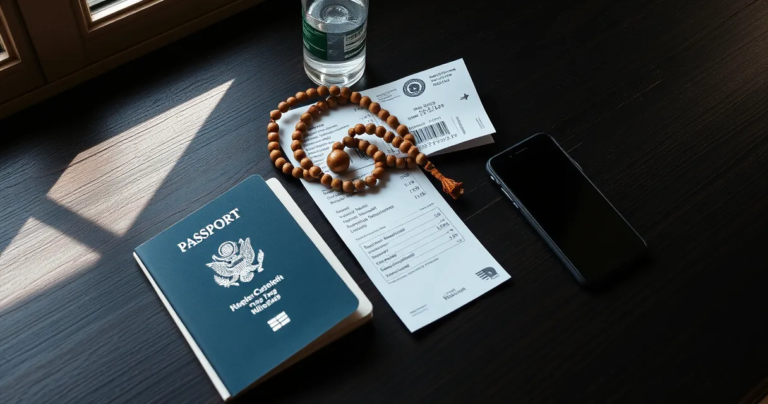
Your carry-on bag for Umrah is not just about liquids limits and entertainment for the flight. It is a functional Miqat preparation kit. It should contain, as a minimum: both Ihram sheets for men, your sandals if they’re small enough, your passport and visa documents, all your daily medications, your phone with the Nusuk app already installed and your permit downloaded, a power bank that’s been checked against airline restrictions (100Wh maximum for most carriers), and one set of fragrance-free toiletries in the approved liquid sizes.
Everything else can go in checked luggage. But those items need to be reachable without involving the overhead locker of the person three rows ahead of you.
Documents: What’s Mandatory and What’s Sensible
Your Umrah permit is now issued through the Nusuk platform, and the digital version on your phone is the accepted proof. That said, I still tell every pilgrim I work with to screenshot the permit and save it offline before they leave the UK, because airport WiFi is unreliable, roaming doesn’t always connect the second you land, and the moment you want to show a confirmation is always the moment your phone has 2% battery.
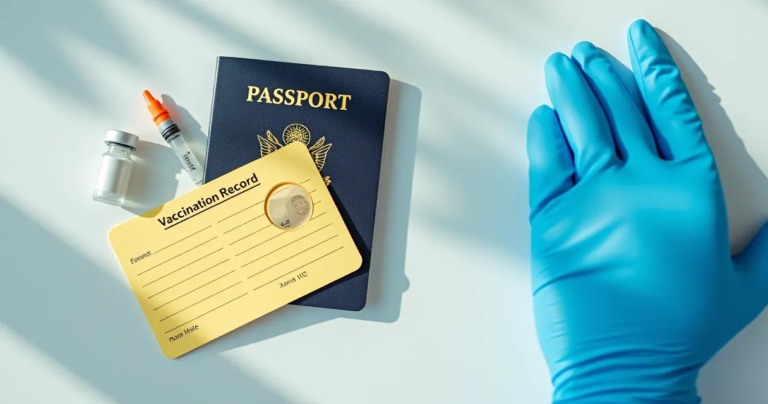
Your passport needs at least six months validity beyond your return date, checked well before you book flights. Your Nusuk permit confirmation should be saved offline, not just to the app. The meningitis ACWY certificate is the one that catches people out: it has to be administered at least ten days before you arrive, so getting it the week before you fly won’t do. Travel insurance needs to cover medical evacuation explicitly, not just the standard package.
It’s also worth printing your hotel booking for both cities and keeping it folded in your document pouch. Reception in Makkah will often ask for it even when everything was booked digitally. Your travel agent’s emergency number should be written down somewhere physical too, not stored only in your phone.
A waterproof neck wallet or document pouch worn under your clothing is the right way to carry these. Not a shoulder bag. Not a back pocket. The crowd levels around the Haram during Umrah, particularly near the Kaaba during Tawaf, are the kind where pickpocketing is genuinely possible even without any malicious intent, just the sheer compression of people.
The Ihram Kit: What Men Actually Need
Pack two sets of Ihram. This is the one item where the quantity actually matters. Your first set goes on before you enter Ihram at the Miqat. The second is a clean replacement for your Sa’i or for the next day if the first gets damp. Ihram cloth in summer especially, when you’re moving through 43-degree heat for several hours, becomes wearable again after washing but needs time to dry. Having a second set removes that problem entirely.
The belt or Ihram belt is not optional in practice even though it’s not strictly part of the garment. Without it, you’re managing your lower sheet with one hand during Tawaf, which makes counting circuits significantly harder. The unstitched money belt versions double as a place to keep your phone and permit, which is exactly where you want them.
Sandals for Ihram should be the kind that leave the back of the foot, heel, and top of the foot partially exposed. The traditional guidance requires that the foot not be fully enclosed. Most experienced pilgrims I see are in sandals or flip-flops. What you can’t do is buy a new pair the week before and assume they’ll hold up across Tawaf. Wear them in at home first. Haram marble gets slippery, especially near ablution areas, and anything without tread becomes a problem on a wet surface.
Underneath your Ihram you can wear a pair of plain, seamless shorts or briefs. This is not widely discussed in packing guides but is practically standard among experienced male pilgrims, particularly for the longer periods of Tawaf and Sa’i. It prevents chafing at the inner thigh across several kilometres of walking.
What Women Actually Need to Pack
For women there’s no single defined Ihram garment. What the state of Ihram requires is that clothing be modest and loose, covering the body. Face and hands stay uncovered — no niqab, no gloves, not during Ihram. Once you’ve completed Umrah and come out of Ihram, normal clothing applies again.
Three or four abayas in lightweight fabric is the right quantity for daily wear. Not your best one. Not the embroidered one you wore to your cousin’s wedding. The kind that can soak in the hotel sink and come out wearable the next morning. Thin synthetics dry faster than cotton and in 40-degree heat that matters more than the fabric feeling nice.
Pack more hijab caps or underscarves than your instinct says. In summer especially, they need changing twice a day. They absorb sweat and sitting in damp fabric for hours is uncomfortable in ways that are easy to avoid. Carry a small supply of hijab pins that aren’t the open safety-pin style, specifically because in Tawaf crowds, a loose pin can become a hazard to people around you.
Menstrual preparation is something most packing guides avoid discussing and shouldn’t. If your period coincides with your Umrah dates, Tawaf isn’t possible until it ends. Worth thinking about before you book, not on the flight over. Some women take hormonal medication to delay their period for the duration of the trip. It’s common practice, but it needs to be arranged with your GP at least a few weeks before travel, not the week before you fly. Going without medication means packing your usual supplies from home. Makkah pharmacies do stock sanitary products but not the full range, and your specific brand probably won’t be there. Tawaf and Sa’i have to wait until menstruation ends — there’s no shortcut around this one. A well-structured itinerary builds that time in. Tell your travel agent when booking.
Closed-toe trainers or flat shoes beat sandals for women doing Umrah. Between Tawaf and Sa’i you’re covering roughly 15 kilometres across multiple sessions, and by day two, anything that isn’t genuinely broken in is going to be a problem. Bring shoes you have already walked in extensively at home.
Toiletries: The Fragrance-Free Rule in Practice
The rule during Ihram is no fragrance. Simple enough until you’re standing in Boots trying to figure out which of the forty deodorants actually qualifies. “Unscented” is not what you want. Unscented just means the original smell was covered up by something else. “Fragrance-free” means nothing fragrant is in the formula at all. Two words on the label. That’s what you’re looking for.
What needs to be fragrance-free: your deodorant (Dove Sensitive and Simple both pass; they’re the two I always recommend), soap or body wash, shampoo, and anything else you put on your skin. Toothpaste is technically fine — mint is a flavour, not a fragrance, though check the label if you’re not sure. Lip balm and moisturiser count too. Get all of this sorted before you leave the UK rather than trying to read Arabic labels at a Makkah pharmacy under time pressure.
Sunscreen goes on during Ihram as long as it’s fragrance-free. In summer this isn’t optional. SPF 50 on the back of the neck, the tops of the feet in sandals, the face.
Anti-chafe balm is what gets forgotten and regretted earliest. Over 10 to 15 kilometres in that heat, often in loose cloth, the inner thighs and underarms are the first things to go. Bring it from home. It may or may not be available in Makkah.
For the volumes: you don’t need to bring full-sized bottles of everything. A week-long Umrah trip requires a fraction of what most people pack in toiletries. Travel-size containers for liquids in your carry-on, and a medium bottle of each core product for your checked luggage, is enough.
Medications: Bring More Than You Think
There is something called the Umrah flu and almost every pilgrim catches it or passes through it. You’re in the same enclosed spaces as people from several dozen countries, shoulder to shoulder at the Kaaba, and whatever’s circulating, you’ll likely meet it. Cold tablets and throat lozenges go in the bag. A decongestant too. Whatever you take regularly for anything, bring a week’s worth extra beyond what the trip actually needs.
Paracetamol and ibuprofen go in without thinking. Beyond that, pack something for an upset stomach because the diet and water change affects a meaningful number of pilgrims, particularly in the first few days. Oral rehydration sachets: every pilgrim I know who’s ended up struggling in heat has wished they’d had them. Water alone when you’re already dehydrated from heat or a stomach upset doesn’t fix you as fast as you’d expect. The sachets do.
Take your prescription medication in its original packaging, pharmacy label on it, not decanted into a weekly pill organiser. Saudi customs take this seriously and unexplained tablets cause delays. A GP letter for anything controlled or unusual is worth having. Split your supply between carry-on and checked bag rather than putting it all in one place.
For the feet specifically: blister plasters (not just standard plasters) and a small pair of scissors for trimming them. After Ihram, you can also bring nail scissors for general use, but not in your carry-on as they’ll be confiscated at security.
Elderly pilgrims and anyone with heart conditions, diabetes, kidney disease, or respiratory conditions should consult their GP before the trip and carry a written summary of their medical history and current medications. The Haram has first aid on site. If you need actual medical care, the hospitals in Makkah are well-staffed and generally have English speakers at the larger facilities.
Electronics: What Actually Helps
Your phone is your most important piece of equipment, not because of the camera but because of the Nusuk app. Install it before you leave the UK. Download your Umrah permit to the app while you still have reliable internet. Screenshot it as a backup. Your permit is single-use per season and is what gets you through the Haram entrance gates, so losing access to it is not a minor inconvenience.
A power bank is essential and should live in your day bag for Haram visits. Charging points inside the Haram aren’t reliable to plan around. You can be there for three or four hours in a single visit, phone on the whole time for navigation and your Nusuk permit. 10,000mAh hits the right balance: enough to keep your phone going through a long Haram visit without the bank itself becoming something you resent carrying.
If you want connectivity without the airport SIM kiosk queue, get an eSIM before you leave. A Saudi Arabia data plan installed at home activates as soon as you’re in range of a Saudi tower, which is while you’re still on the runway. No roaming surprises. The main UK networks also do Saudi roaming day-passes if you’d rather not set up an eSIM. Plugs are not a problem for UK travellers: Saudi sockets are Type G, identical to ours, so no adaptor is needed.
Everything else is secondary. Earphones for Quran or duas when you’re sitting in the mosque, though put them away during Tawaf and Sa’i when you should be reciting. A charging cable that lives in the day bag so it’s always there. That’s the list. Leave the DSLR or mirrorless at home. Photography rules near the Kaaba are enforced and a camera that looks professional flags you to Haram security faster than anything else.
The Day Bag: What to Carry Into the Haram
This section doesn’t appear in most packing lists because most packing lists are about what to fit in your suitcase, not what to carry on your person during the actual rituals. It matters.
A small drawstring bag or a slim crossbody bag is what you want for Haram visits. It should fit your phone, a small bottle of water, your Nusuk permit screenshot, a few dates (genuinely useful, high energy and widely eaten for exactly this reason), a pair of clean socks if you’re going barefoot inside the mosque and want something to put on when leaving, and your Ihram belt or money belt if you’re male.
Leave your passport in the hotel safe, not in your day bag. Large amounts of cash too. Sharp objects won’t get through security anyway, and a bag too large or heavy to check quickly means you’re holding up everyone behind you in the queue. The Haram entrances screen bags and the lines build fast at peak times. Something small that goes through in one look is what you want.
Your footwear comes off at the entrance. Bring a small plastic bag to carry your sandals or shoes inside the mosque if you’re going to an upper level, as leaving footwear at the entrance and then trying to find it in a crowd of thousands doesn’t work well in practice.
The Makkah-to-Madinah Transfer Bag
After Umrah in Makkah, most pilgrims head to Madinah for Ziyarat. The Haramain High Speed Railway connects the two cities in about two hours and twenty minutes. You board from Makkah station or from Jeddah King Abdulaziz Airport, depending on how your itinerary is structured.
The practical consequence for packing is that you’re moving cities mid-trip with your full luggage, and what you need for the train and the first few Madinah hours shouldn’t require opening your main case on a station platform. Pack a separate small holdall or day bag with what you need for the Madinah leg: one or two changes of clothing, your toiletries for overnight, your medications, chargers, and prayer items. Your main suitcase goes in the hotel luggage hold or directly to the Madinah hotel depending on your tour arrangement.
The Haramain train requires a booking, which your UK travel agent should have arranged as part of your package. Keep the booking reference in the same place as your Nusuk permit, on your phone, with a screenshot backup.
What to Buy in Makkah Rather Than Bring
A genuine gap in most packing guides: they tell you to bring everything and then mention in passing that “items are available in Makkah.” Here’s a more honest breakdown of what to leave behind at home and buy on arrival.
Dates: Makkah has the best dates in the world at extraordinarily low prices. Buying them at home and carrying them is pointless. The markets around the Haram, particularly in the Abraj Al-Bait shopping area and the underground souk, have an enormous range. Buy them fresh there.
Prayer beads (tasbih): widely available in every price range, from simple wooden beads to more elaborate ones. Leave yours at home unless it has sentimental value.
Zamzam containers: you can bring Zamzam water back to the UK, but buy the containers in Makkah. You’re allowed five litres per person as hand luggage from Jeddah airport, and the plastic containers specifically designed for this are sold everywhere near the Haram.
An extra thobe or abaya: if you’re going for a week or more, buying one in Makkah is inexpensive and you’ll have more choice than anything you’d find in the UK at a comparable price point. The quality varies widely but the options are extensive.
Ittar or fragrance: after you exit Ihram, many pilgrims choose to buy ittar (non-alcoholic fragrance oil) in Makkah. The selection is substantial and significantly more varied than what UK Islamic shops carry. Leave the expensive cologne at home and explore what’s available on the ground.
What to Leave Behind
This is the section that most packing guides treat as an afterthought. Given that “what to leave” is literally half the title of this piece, it deserves proper attention.
More than two pairs of shoes. One pair of sandals for Ihram, one pair of decent trainers for regular wear. That covers everything. Whatever number you’re currently thinking of bringing beyond that, leave it at home.
Physical books beyond a small pocket Quran or dua book. Every supplication, every hadith, every transliteration you’d want is on your phone already. The Quran and Hisnul Muslim apps both work offline and are free. I know some pilgrims feel strongly about physical books, bring one if you must, just not three.
Expensive jewellery and watches. Leave them at home entirely, not just in the hotel safe. You’re going to be pressing through crowds, walking kilometres on marble, possibly getting soaked at ablution areas. Nothing you wear in Makkah should be something you’d be upset to lose.
A drone. Don’t. Saudi customs confiscate them at the border and the penalties beyond confiscation aren’t trivial. Every few months another pilgrim posts about this online. It’s not worth it.
More than roughly 60,000 Saudi riyals in cash (approximately 13,000 GBP). Amounts above this threshold require declaration at Saudi customs. Most pilgrims don’t come close to this but it’s worth knowing. Cards are widely accepted at Makkah hotels and the Abraj Al-Bait mall. Use a card for larger purchases and carry riyals for smaller transactions and the local souks.
Heavily scented products of any kind, even for after Ihram. Your fellow pilgrims are in Ihram and strong fragrances applied in shared spaces cause genuine discomfort for others. Keep perfume minimal and apply it in your own room.
A second suitcase brought as shopping space. I understand the logic, and I’ve watched enough pilgrims regret it to be direct: Jeddah airport with two large cases plus a carry-on at midnight is not the arrival you want. The Haramain train station is worse. One checked bag. One carry-on. If you buy things in Makkah you can’t fit in, pack them into the bags you have or leave them.
Packing for Specific Situations
If you’re packing for an elderly relative or for yourself with mobility considerations, add to the standard list: compression socks for the long-haul flight and for periods of standing during Tawaf, a lightweight folding walking stick or trekking pole if normally used at home (these are permitted in the Haram), knee support if there’s any existing knee difficulty, and a small cooling towel for managing heat. The Haram has electric wheelchair and buggy services available year-round, but availability during busy periods is not guaranteed. Discuss this with your travel agent when booking.
If you’re travelling with children, the key additions are a foldable lightweight pushchair for children too young to walk the distances involved, a backpack carrier for younger children if the pushchair becomes impractical in the Haram crowds, children’s medications and any specific dietary items they’ll definitely eat, and a small familiar toy or comfort item for settling them in the hotel. Keep children in sun-protective clothing during any outdoor time, and never do Tawaf with children in summer heat between 10am and 6pm.
If it’s your first Umrah, focus on packing light and packing what you know. This is not the trip to experiment with new footwear or untested toiletry brands. Bring the shoes you walk in daily at home. Bring the soap you use daily at home in a fragrance-free version. The cognitive load of the rituals for a first-time pilgrim is already significant without managing clothing or equipment failures at the same time.
For summer Umrah (June through September), the additional items that move from nice-to-have to essential are: a compact cooling towel, a refillable water bottle (Zamzam dispensers are available throughout the Haram and you should be drinking from them constantly), SPF 50 fragrance-free sunscreen, and sandals with serious grip for walking on wet marble. Leave any heavy fabrics at home entirely. Your suitcase should be light and primarily clothing.
For winter Umrah (November through February), the addition is one warm layer for Madinah specifically. Madinah at night in January can drop below 12 degrees, which surprises most UK pilgrims who packed for the Makkah daytime heat. A packable fleece or light down jacket takes minimal space and is essential for the early morning walks between the hotel and Masjid al-Nabawi.
Questions People Actually Ask
Can I bring my phone into Masjid al-Haram? Yes. Phones are permitted throughout the Haram. Photography near the Kaaba is permitted in general areas, though Haram security restricts filming in certain locations and rules can change. Keep your phone in your bag during Tawaf rather than holding it up, both for etiquette reasons and because a raised phone is harder to hold onto in a dense crowd.
Can I wear glasses during Ihram? Yes. Prescription glasses are permitted during Ihram with no restriction.
How many sets of Ihram should a man pack? Two is the minimum. Three if you’re going for more than ten days. More than three is unnecessary weight.
Can I use sunscreen during Ihram? Yes, provided it is genuinely fragrance-free. Check the label specifically for the words “fragrance-free” rather than “unscented.”
What if I forget something? For most items, Makkah is very well supplied. The areas around the Haram have pharmacies, convenience shops, and clothing stores covering almost every basic need. Items that are harder to find: specific prescription medications, children’s medicines in familiar UK brands, specialist fragrance-free toiletries, and specific food items for dietary requirements. For everything else, assume you can buy it there.
Do I need a travel adaptor for Saudi Arabia? UK pilgrims do not. Saudi Arabia uses Type G sockets, the same as the UK. US and European pilgrims need a universal adaptor.
Can I bring Zamzam water back to the UK? Yes. The UK permits Zamzam water for personal use. At Jeddah airport, you can purchase sealed Zamzam in approved containers, and five litres per person is the typical airline allowance for carry-on in the specific Zamzam packaging. Check with your airline for the exact allowance as policies vary between carriers.
What items are banned in Saudi Arabia? Alcohol, all narcotics and controlled substances without documentation, pornographic material, pork products, weapons, drones, and any item for commercial resale without the appropriate licence. At Saudi customs, cash amounts above SAR 60,000 must be declared.
The full packing list ultimately comes down to this: bring what you actually need, leave what you might need, and trust that what you forget can be bought. Makkah is not a remote destination. It is a sophisticated city with extensive retail infrastructure catering specifically to pilgrims. What matters more than a complete packing list is a well-thought-out carry-on strategy, a light suitcase you can move between two cities without help, and the mental clarity that comes from not having over-packed.
If you’re booking your Umrah from the UK and want help thinking through your itinerary before you start worrying about the packing, you can view our Umrah packages or speak to the team directly. We also have a detailed guide on when to go if you’re still deciding on timing.
Medication aside, there is one jab you cannot travel without. The Umrah injection requirements cover the MenACWY rule and the 10 day deadline that catches people out.