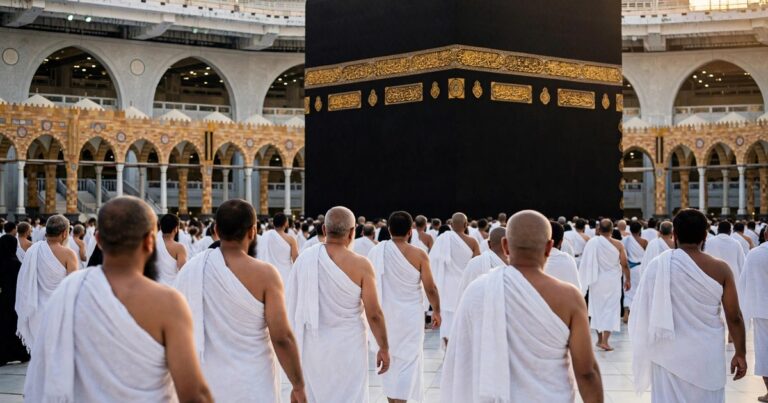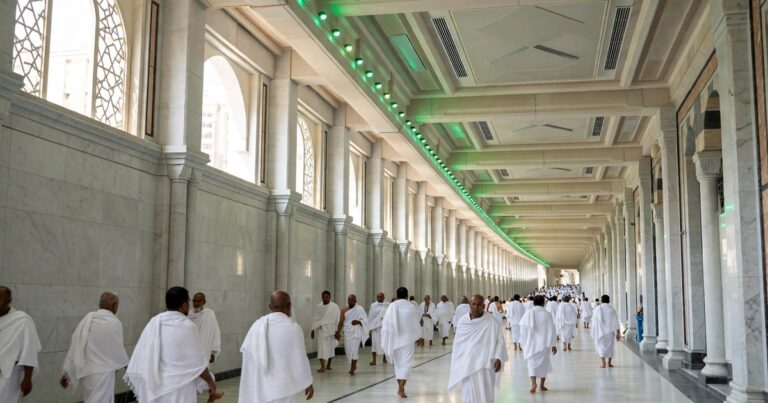
Ihram for men is two unstitched white sheets: the izar, wrapped around the waist and reaching below the knee, and the rida, draped over the upper body. Nothing sewn or fitted may be worn, the head stays uncovered, and footwear must leave the heel and the top of the foot exposed. You enter this state at the Miqat boundary with the intention and the Talbiyah, and remain in it until you complete Tawaf, Sa’i and cut your hair. Your Umrah permit, booked through the Nusuk platform, needs to be on your phone before you set off.
The garment is the easy part. What catches men out on flights from the UK is the timing, because the Miqat is crossed in the air, usually without an announcement, and Ihram has to be on before it happens. That problem gets its own section below because it is the single most common failure point of the whole trip.
What Are the Two Pieces of Ihram?
The izar is the lower sheet. It wraps around the waist like a towel and must cover from the navel to below the knee. It is held with a belt, which is not technically part of the garment but is close to essential in practice.
The rida is the upper sheet. It goes over the shoulders and covers the torso. During most of your time in Ihram both shoulders are covered. During Tawaf of Umrah, many men perform Idtiba, passing the rida under the right armpit so the right shoulder is bare, which is a recommended practice rather than an obligation.
Both sheets must be unstitched. This is the defining rule of male Ihram and it rules out anything tailored, seamed or shaped to the body: no underwear, no vest, no trousers, no shirt, no fitted hat. The point is that every man stands at the Kaaba in the same two lengths of cloth regardless of what he owns.
White is the standard and near-universal choice. Plain, unpatterned, and white enough that it does not become transparent when wet, which cheap sheets do.
How Many Sets of Ihram Should You Pack?
Two, minimum. Three if you are going for more than ten days.
The reasoning is practical rather than ritual. Ihram cloth in 43-degree heat, worn through a kilometre of Tawaf and three kilometres of Sa’i in a dense crowd, does not stay fresh. Washing it is straightforward. Getting it dry is not, particularly in an air-conditioned hotel room with limited hanging space. A second set removes the problem entirely, and a spare also covers the situation where a sheet is torn or soiled mid-trip.
Pack the first set in your carry-on, not the hold. The reason for that is the next section.
When Do You Put On Ihram Flying from the UK?
Before you board, or in the aircraft cabin before the Miqat is crossed. Not after landing in Jeddah.
Flights from the UK to Jeddah cross the Miqat boundary at Yalamlam while still at cruising altitude, roughly 45 to 60 minutes before landing. Some airlines announce it. Many do not, or announce it in Arabic only, or announce it once quietly over a cabin where most passengers are asleep. Crossing the Miqat without being in the state of Ihram, when you intend Umrah, requires either returning to a Miqat to enter properly or paying a fidyah, which is a sacrifice made in Makkah.
There are three ways men handle this, in descending order of how relaxed the flight is:
Change at home or at the UK airport. Put the Ihram on before you leave, or in the airport changing facilities before boarding. You then fly in Ihram. This is what most experienced pilgrims do. It is entirely permissible to make the formal intention later, in the air, before the Miqat.
Change on board. Ask the crew when the Miqat is expected, use the lavatory to change roughly 90 minutes before landing, and make the intention at your seat. Workable, but aircraft lavatories are small and the queue at that point in a flight is long.
Change at Jeddah on arrival. This is too late for the Miqat. It only works if you are flying to Madinah first, spending time there, and entering Ihram at Dhu’l-Hulayfah on the way to Makkah.
Whichever you choose, your Ihram, belt and sandals belong in your carry-on. A pilgrim whose Ihram is in the hold at 35,000 feet has no options at all. Our Umrah packing list covers the full carry-on strategy for this.
What Footwear Is Allowed in Ihram?
Sandals that leave the heel and the upper part of the foot exposed. The classical position is that the foot must not be fully enclosed, which rules out trainers, shoes and anything with a closed back.
Buy them well in advance and wear them in at home. New sandals across roughly four kilometres of marble, some of it wet near the ablution areas, is how pilgrims end up with blisters on day one of a ten-day trip. Grip matters more than people expect. Haram marble is polished and becomes genuinely slippery around the Zamzam and wudu areas.
Socks are not permitted while in Ihram. After you exit Ihram, normal footwear and socks resume.
What Breaks Ihram for Men?
| Prohibited | Consequence if done deliberately |
|---|---|
| Wearing stitched or fitted clothing | Fidyah |
| Covering the head directly | Fidyah |
| Applying perfume or scented products | Fidyah |
| Cutting hair or nails | Fidyah |
| Marital relations before completing the rites | Invalidates the Umrah |
| Contracting or proposing marriage | Sinful, does not invalidate |
| Hunting or killing game | Expiation |
Fidyah for the minor violations is conventionally one of three options: fasting three days, feeding six poor people, or sacrificing a sheep. Any of the three discharges it.
Now the part that matters more, because most of what men worry about is not prohibited at all:
You may shower and wash, including your hair, using unscented soap. Wear a watch, glasses, a ring, or a hearing aid. Carry a bag or money belt. Sit or sleep under a roof, in a car, or under an umbrella held above you. Change your Ihram sheets. Use a phone. Wear a belt. Cover your face if needed, which for men is permitted although women may not.
The head rule is specific: your head must not be covered by something resting directly on it. A cap, turban or hood is prohibited. Shade from an umbrella, a vehicle roof or a building is not, because it does not rest on the head.
Can You Wear Underwear Under Ihram?
Not conventional underwear. Briefs and boxers are stitched and fitted, which places them squarely within the prohibition on tailored clothing while in Ihram.
This is the question men ask most and the answer is genuinely inconvenient, because several kilometres of walking in loose cloth causes chafing at the inner thigh. The practical mitigations are an anti-chafe balm applied before you begin, which is permitted as long as it is fragrance-free, and a properly fastened izar with a belt so the cloth moves less. Both are worth sorting before you travel rather than discovering at Sa’i.
Some contemporary scholars permit unstitched wrap-style undergarments. If this concerns you, ask a scholar you follow before departure rather than improvising at the Miqat.
Once you have exited Ihram, ordinary clothing including underwear resumes immediately.
How Do You Exit Ihram?
After completing Tawaf and Sa’i, men either shave the head completely, which is Halq, or trim the hair evenly all over, which is Taqsir. Shaving carries greater reward and is the more common choice.
Trimming means shortening the hair across the whole head, not snipping a single lock. Barbers are everywhere around the Haram and the Abraj Al-Bait complex, and they are fast and inexpensive. Use a licensed shop with visibly sterilised equipment rather than an informal street barber.
Once the hair is cut, Ihram ends and every prohibition lifts.
Frequently Asked Questions
How to wear Ihram for men?
Perform ghusl, wrap the izar around the waist so it covers from navel to below the knee and secure it with a belt, then drape the rida over both shoulders. Wear sandals that expose the heel and upper foot, leave the head uncovered, and make the intention with the Talbiyah at or before the Miqat.
Can you wear underwear under Ihram for men?
No. Stitched, fitted underwear falls under the prohibition on tailored clothing. Use fragrance-free anti-chafe balm and a well-secured izar instead.
How to do Ihram for Umrah for men?
Shower, put on the two sheets, and at the Miqat make the intention for Umrah and recite the Talbiyah. From that point the prohibitions apply until you complete Tawaf, Sa’i and cut your hair.
How to put on Ihram for men?
Izar first, wrapped and belted at the waist. Rida second, over both shoulders. Adjust so the izar sits below the knee and cannot slip during Tawaf.
How to tie Ihram for Umrah for men?
Wrap the izar around the waist, fold the top edge over itself, then secure with an Ihram belt. Do not knot the sheet itself. Most scholars discourage tying knots in the Ihram cloth, and a belt is the standard solution.
How many Ihram sets should I bring?
Two as a minimum, three for trips over ten days.
Can you wear a belt in Ihram?
Yes. A belt or money belt is permitted and is standard practice for keeping the izar secure and holding your phone and permit.
Can you cover your head in Ihram?
No, not with anything resting on the head. Shade from an umbrella, a vehicle or a building is permitted because it does not touch the head.
Can you wear socks or trainers in Ihram?
No. Footwear must leave the heel and the top of the foot exposed, which rules out socks and closed shoes until you exit Ihram.
What if I cross the Miqat without Ihram?
Return to a Miqat and enter Ihram properly if you can, or pay a fidyah. This is why the Ihram belongs in your carry-on on flights from the UK, where the Miqat is crossed in the air.
Do women wear the same Ihram?
No. Women wear ordinary modest clothing with the face and hands uncovered. See our companion guide to Ihram for women.
Two sheets, no stitching, head uncovered, feet exposed at the heel. The garment is simple. The part that requires planning is being in it before the aircraft crosses Yalamlam, and that is decided in your carry-on before you leave home.
If you are booking Umrah from the UK and want the Miqat timing handled as part of your itinerary rather than left to chance, view our Umrah packages or speak to the team. Our guide to how long Umrah takes sets out what to expect once you are there.