No. The answer to “do you have to shave your head for Umrah” is that you do not. Men complete Umrah either by shaving the whole head (halq) or by cutting hair from the whole head (taqsir), and both end the state of ihram. Shaving is the better of the two, because the Prophet prayed for mercy on those who shave three times before including those who cut. Women never shave; they cut a fingertip’s length from the ends of their hair.
Do you have to shave your head for Umrah, or is a trim enough?
A trim is enough, but shaving is preferred, because the Prophet asked for mercy on those who shave three times and added those who cut only after the companions pressed him. Ibn Umar narrates in Sahih al-Bukhari 1727 that the Prophet said, “O Allah, be merciful to those who have their head shaved.” The people said, “And those who get their hair cut short.” He repeated the prayer for those who shave, they asked again, and on the third time he said, “And to those who get their hair cut short.” Nafi adds that in another transmission the addition came on the fourth time.
It is a preference of reward, not of validity: the same hadith shows the Prophet granting the prayer to those who cut, and the islamqa ruling on hair in Hajj and Umrah records that scholars agree shaving is better while cutting is also permissible; that ruling, islamqa 82077, is linked in the next section. Where halq or taqsir sits in the sequence of rites is in the guide to how to perform Umrah.
How much hair do you have to cut if you trim?
If you trim, you must take hair from the whole head, not a few strands from the back or one side, according to the majority view. The islamqa ruling states that a person “should not limit himself to removing hair only from the front or the back or the right or the left,” and sets out where the schools differ on the minimum (islamqa 82077).
| School | Minimum that completes taqsir | Source |
|---|---|---|
| Maliki and Hanbali | Hair cut from the whole head; partial cutting is not enough | islamqa 82077 |
| Hanafi | At least a quarter of the head | islamqa 82077 |
| Shafi’i | Three hairs, shaved or cut | islamqa 82077 |
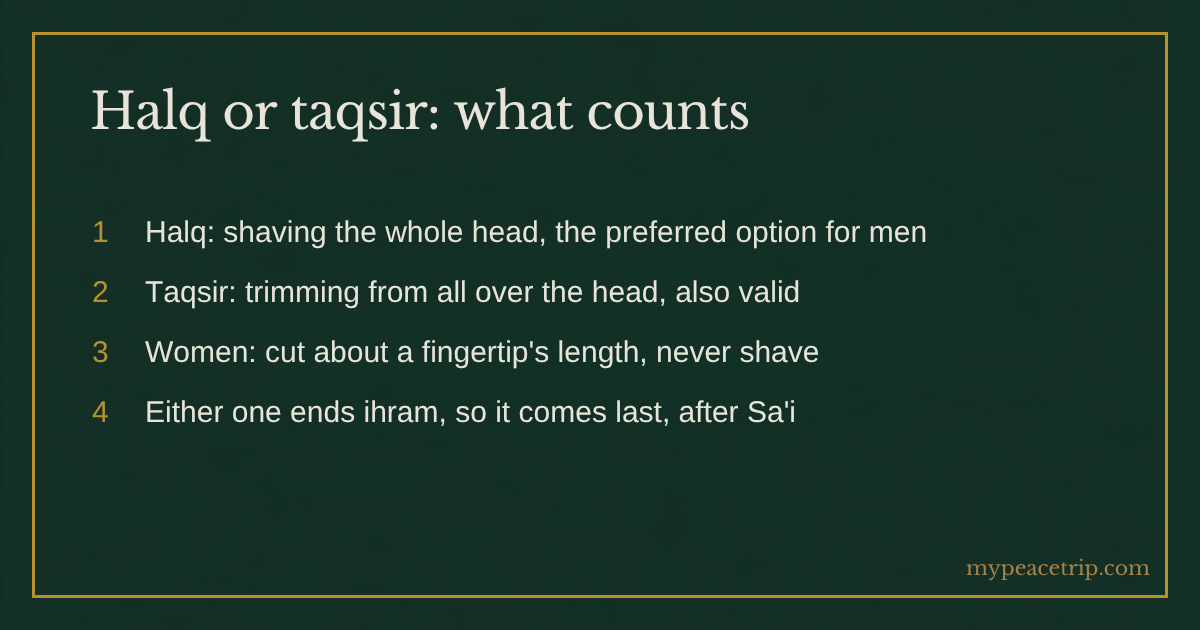
The safe practice, and the one our guides ask for, is a clipper pass over the whole head so that every part is shortened; two or three snips from the fringe satisfy only the Shafi’i minimum. A person who followed a scholar’s opinion in good faith owes nothing for a past Umrah, but should cut from the whole head in future (islamqa 96466).
Do women shave or cut their hair for Umrah?
Women cut, never shave, and there is no difference of opinion on that. The islamqa ruling says a woman gathers her hair, or takes hold of each plait, and cuts a fingertip’s length from the ends, which Shaykh Ibn Uthaymin put at about two centimetres, and that the cut must come from all of the hair, not one lock (islamqa 110804). She may do this herself in the hotel room (islamqa 104197).
Where are the barbers and what do they charge?
The barbers are in the row of shops directly outside the Marwa exit of Masjid al-Haram, and their fee is small and varies, so there is no fixed figure to quote. Walk out at the top of Marwa after the seventh length of Sa’i and the first thing you meet is a line of barber shops with numbered chairs, clippers and disposable razors. They shave in under five minutes and take cash; fees change by season and by shop, and the shops nearest the exit charge more than those a street back.
Ask for a new blade and watch it opened. If you would rather not shave among strangers, your hotel barber is fine, and a family member can do it in the room, since a pilgrim may shave his own head or have someone else do it, as the islamqa ruling cited in the women’s section above states. You remain in ihram until the hair is cut, so the restrictions in the guide to ihram for men still apply on the walk from Marwa to the chair. Someone who changed into ordinary clothes before the cut puts the ihram back on, cuts the hair, and then changes, with no penalty if it was done in ignorance (islamqa 122795).
Should you trim if you plan a second Umrah?
If you plan a second Umrah within a few days, you may cut rather than shave the first time so that hair is left, or shave both times; the ruling for a shaved head with no regrowth is simple. Shaykh Ibn Uthaymin’s answer states that a person who shaves, then performs another Umrah before any hair has grown, does not need to pass the razor again and leaves ihram after Sa’i; but if even a little hair has appeared, the razor is passed over it (islamqa 95439). Hair can show within a day, so most pilgrims who repeat Umrah from Tan’im simply visit the barber again.
Our Umrah packages include a guide who stays with the group from Sa’i to the barber row and checks the cut before anyone changes out of ihram. Prices show in your own currency; a reader in Pakistan sees rupees.
Frequently Asked Questions
Why do Muslims go bald after Umrah?
Muslim men shave their heads after Umrah because cutting the hair is the act that ends ihram, and shaving is the form the Prophet prayed for three times in Sahih al-Bukhari 1727 before adding those who trim. Shaving is not compulsory; a trim from the whole head also completes Umrah, which is why some men leave Makkah with short hair rather than none.
What makes Umrah invalid?
Sexual intercourse before Sa’i is completed invalidates Umrah, according to the islamqa ruling on the subject; the person must still finish the spoiled Umrah, repeat it from the miqat, and offer expiation. Intercourse after Sa’i but before the hair is cut does not invalidate it but requires a fidyah of a sheep, three days of fasting, or feeding six poor people (islamqa 119134).
Can you cut your own hair after Umrah?
Yes. A man may shave or cut his own head and a woman may cut her own hair to leave ihram, and either may cut another pilgrim’s hair, according to Shaykh Ibn Uthaymin’s ruling on islamqa 104197. The requirement is that the cut covers the whole head for a man, and a fingertip’s length from all of the hair for a woman.
What happens if you forget to cut your hair after Umrah?
You remain in ihram until the hair is cut, so if you changed into ordinary clothes without cutting, you put the ihram garments back on, shave or cut, and then change again. The islamqa ruling 122795 states that there is no penalty for what was done in ignorance, but the cut itself cannot be skipped, because it is the act that ends ihram.