How to perform Umrah comes down to four things in order: enter the state of ihram at the miqat with the Talbiyah, walk seven circuits around the Kaaba (Tawaf), walk seven lengths between the hills of Safa and Marwa (Sa’i), and cut your hair. Between Tawaf and Sa’i you pray two rak’ahs behind the Station of Ibrahim. That is the whole of it. The rites can be completed in a few hours, and nothing in them requires you to wait, return the next day, or perform anything at a fixed time.
This guide follows the sequence exactly as Jabir ibn Abdullah described the Prophet performing it, recorded in Sahih Muslim 1218a. Where guides disagree with each other, that narration is the tie-breaker, and it is cited at every step below.
How to perform Umrah: what are the four steps?
Ihram, Tawaf, Sa’i, and halq or taqsir. The two rak’ahs after Tawaf sit between the first two and are part of the sunnah rather than a separate pillar.
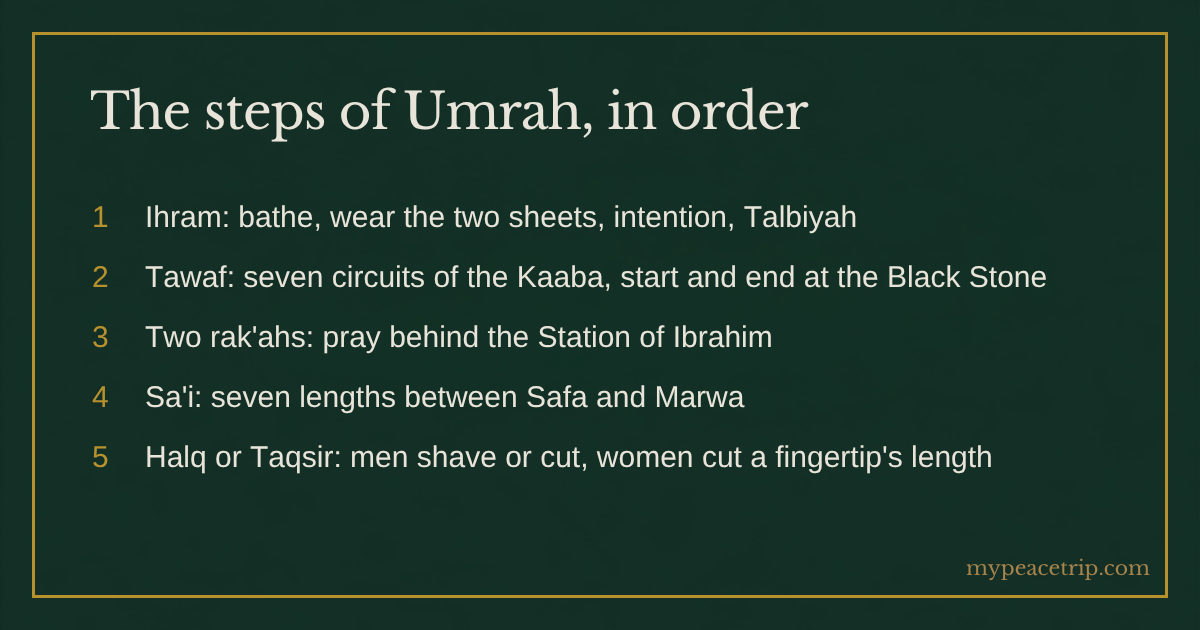
| Step | What you do | Where | Fixed words |
|---|---|---|---|
| 1. Ihram | Bathe, wear the two sheets (men), make intention, say the Talbiyah | At or before the miqat | Talbiyah |
| 2. Tawaf | Seven anticlockwise circuits of the Kaaba, starting and ending at the Black Stone | Mataf, ground floor or upper levels | Allahu Akbar at each start; one verse between the two corners |
| 3. Two rak’ahs | Pray behind the Station of Ibrahim | Anywhere in the mosque if crowded | Verse 2:125, then al-Kafirun and al-Ikhlas |
| 4. Sa’i | Seven lengths, Safa to Marwa counts as one | The covered walkway between the hills | Verse 2:158 at Safa; declaration on each hill |
| 5. Halq / Taqsir | Men shave or cut; women cut a fingertip’s length | Barbers by the exit, or your hotel | None required |
The duas for each step are in a separate guide with the Arabic and transliteration. This page is about the actions.
How do you start Umrah, and where is the miqat?
Umrah begins when you enter ihram, and ihram must be entered at or before the miqat, the boundary you cross on the way to Makkah. For pilgrims flying into Jeddah from the UK, Pakistan, India, Indonesia or Malaysia, the aircraft crosses the miqat in the air, and the cabin crew announce it roughly an hour before landing. Change into your ihram at the departure airport or during the flight, and make the intention when the announcement comes.
If you go to Madinah first, you enter ihram at Dhul Hulaifah (called Abyar Ali locally), the miqat the Prophet himself used according to Jabir. The coach stops there.
Before ihram, the sunnah is to bathe, trim nails, and remove unwanted hair. Men then wear two unstitched white sheets and nothing sewn: no shirt, no trousers, no turban, no hooded cloak, and no shoes that cover the ankle, as the Prophet listed when asked in Sahih al-Bukhari 1542. Women wear ordinary modest clothing with the face and hands uncovered. The full clothing rules for each are in the guides to ihram for men and ihram for women.
Then make the intention for Umrah in your heart and say the Talbiyah, which Ibn Umar gives word for word in Sahih al-Bukhari 1549:
Labbayk Allahumma labbayk. Labbayka la sharika laka labbayk. Innal-hamda wan-ni’mata laka wal-mulk. La sharika lak.
From that moment you are a muhrim. Keep repeating the Talbiyah until you reach the Kaaba.
Can a woman enter ihram while bleeding?
Yes. This is one of the clearest points in Jabir’s narration and one of the least repeated. Asma bint Umais gave birth to Muhammad ibn Abi Bakr at the miqat of Dhul Hulaifah, and sent to ask the Prophet what she should do. He told her to bathe, bind herself with a cloth, and enter ihram.
So a woman in menstruation or postpartum bleeding travels, enters ihram, says the Talbiyah and does everything except Tawaf and the prayer that follows it. She waits until the bleeding stops, bathes, and then performs Tawaf, the two rak’ahs, Sa’i and cutting her hair in the normal order. Sa’i is not performed until Tawaf has been.
What are the restrictions of ihram?
Once in ihram, until you cut your hair at the end:
- No cutting hair or nails
- No perfume on the body or clothes
- No sewn clothing for men, and nothing covering the head
- Women do not cover the face with a niqab or the hands with gloves
- No hunting
- No marriage contracts, and no intimacy or its preliminaries
Washing, changing your ihram sheets, using unscented soap, wearing a watch, glasses, a money belt or sandals, and sheltering under an umbrella or a roof are all permitted. If you break a restriction by forgetting, there is no penalty; you stop as soon as you remember.
How do you perform Tawaf?
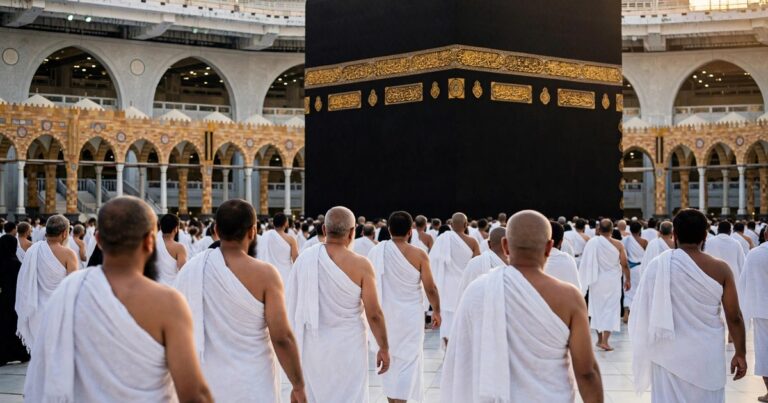
Tawaf is seven circuits of the Kaaba, anticlockwise, with the Kaaba on your left, beginning and ending in line with the Black Stone. You must be in a state of wudu, and the mosque itself does not close, so you can perform it at any hour.
Jabir describes the Prophet touching the corner, walking briskly for the first three circuits and at a normal pace for the last four. Two details from that sentence are worth holding onto:
- The brisk walk is for the first three circuits only. Guides that say “walk briskly during Tawaf” are half right. It is called raml, it is for men, and it ends after the third circuit.
- He touched the Black Stone and kissed it. If the crowd allows you to touch it, do so. If it does not, and it usually does not, raise your right hand towards it as you pass, say Allahu Akbar, and keep moving. Do not push. Kissing the Stone is a sunnah, not a condition of Tawaf.
Between the Yemeni corner and the Black Stone on each circuit the Prophet said “Rabbana atina fid-dunya hasanatan wa fil-akhirati hasanatan wa qina adhaban-nar”, recorded in Sunan Abi Dawud 1892. For the rest of each circuit, pray for whatever you wish, in any language. There is no set dua per circuit, despite the booklets that assign one.
Count carefully. Most people use the seven fingers method or a simple counter ring. If you lose count, take the lower number.
What do you do after Tawaf?
Go to the Station of Ibrahim, the small glass and gold enclosure a few metres from the Kaaba door, and pray two rak’ahs with the Station between you and the Kaaba. Jabir records the Prophet reciting the verse “And take the Station of Ibrahim as a place of prayer” (Quran 2:125) as he went there, then reading Surah al-Kafirun in the first rak’ah and Surah al-Ikhlas in the second.
The area directly behind the Station is small and is often roped off during busy periods. Praying anywhere in the mosque is valid; the position is the sunnah, not a condition.
After the prayer, drink Zamzam. Coolers are on every level. Then, if you can reach it, touch the Black Stone once more before leaving for Safa, as the Prophet did.
How do you perform Sa’i between Safa and Marwa?
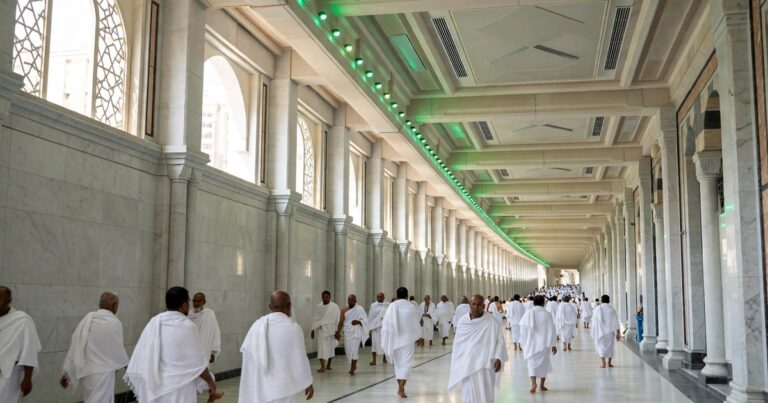
Sa’i is seven lengths between the two hills, starting at Safa and finishing at Marwa. Safa to Marwa is one; Marwa back to Safa is two; and so on, ending on the seventh at Marwa.
Why Safa first? Jabir records the Prophet reciting the verse “Indeed Safa and Marwa are among the symbols of Allah” (Quran 2:158) as he approached, then saying: “I begin with what Allah began with.” The verse names Safa first, so he started there.
On Safa, climb until you can see the Kaaba through the archway, face it, raise your hands, and say three times:
La ilaha illallahu wahdahu la sharika lah, lahul-mulku wa lahul-hamdu wa huwa ala kulli shay’in qadir. La ilaha illallahu wahdah, anjaza wa’dah, wa nasara abdah, wa hazamal-ahzaba wahdah.
Make your own dua between each repetition. Then walk to Marwa. Between the two green lights in the walkway, men walk fast; Jabir says the Prophet ran where the ground dropped into the valley and walked when it rose. Women walk at a normal pace throughout. On Marwa, do exactly what you did on Safa, and repeat until the seventh length ends at Marwa.
Wudu is recommended for Sa’i but not required, which is why a woman whose period begins after Tawaf can still complete Sa’i.
How do you finish Umrah?
Cut your hair. Men either shave the whole head (halq) or cut hair from all of it (taqsir); shaving is better, because the Prophet asked Allah’s mercy on those who shave three times before including those who cut, in Sahih al-Bukhari 1727. Women gather the hair and cut a fingertip’s length from the end.
Barbers are lined up at the Marwa exit and charge a few riyals. Your hotel barber is also fine. Once the hair is cut, the restrictions of ihram end, you change into ordinary clothes, and your Umrah is complete.
How long does the whole thing take?
The rites themselves, from entering the mosque to leaving the barber, take between two and four hours depending on crowds, and most of that is Tawaf. Ramadan and the last ten nights are the exception, where Tawaf alone can take over an hour. Our separate guide on how long Umrah takes covers timings for the trip as a whole, including visa and travel days.
Nothing requires you to spread the rites across days. Jabir’s account is continuous: Tawaf, then the two rak’ahs, then Sa’i, then the instruction to cut hair and leave ihram, all in one visit to the mosque.
What mistakes do first-timers make when learning how to perform Umrah?
- Entering ihram after the miqat. Change and make intention before the announcement on the plane, not on landing.
- Doing raml for all seven circuits. Three only, then walk.
- Pushing to reach the Black Stone. Raising your hand towards it is a complete substitute.
- Losing count. Use a counter. If in doubt, take the lower number.
- Treating the booklet duas as compulsory. They are not; the three fixed recitations are the Talbiyah, the verse at Safa, and the declaration on the hills.
- Cutting a symbolic few strands. Hair must be taken from the whole head, or a fingertip’s length from a plait for women.
Ready to go?
If you want the practical side handled, our Umrah packages include hotels within walking distance of the Haram, transfers between the airport, Makkah and Madinah, and a guide who walks you through each step above on the day. If you are choosing where to stay, start with the hotels near Masjid al-Haram.
Frequently Asked Questions
What to say when performing Umrah?
The Talbiyah from ihram until Tawaf begins; Allahu Akbar at the start of each circuit; “Rabbana atina fid-dunya hasanah” between the Yemeni corner and the Black Stone; the verse “Innas-Safa wal-Marwata min sha’a’irillah” as you approach Safa; and “La ilaha illallahu wahdahu la sharika lah” three times on Safa and Marwa. Everything else is your own supplication.
How do I start Umrah?
By entering ihram at or before the miqat: bathe, wear the ihram clothing, make the intention for Umrah, and say the Talbiyah. For pilgrims flying into Jeddah the miqat is crossed in the air and announced by the crew.
Can Umrah be done in one day?
Yes. The rites are continuous and take a few hours. The Prophet performed Tawaf, the two rak’ahs and Sa’i in a single visit, and told the companions to cut their hair and leave ihram immediately afterwards.
How many walking steps to complete Umrah?
Seven circuits of Tawaf and seven lengths of Sa’i. The distance depends on which level of the mosque you use and how full the mataf is; the outer rings of Tawaf on the upper floors are several times longer than the inner ring. Plan for a few kilometres in total and wear sandals you have already walked in.