The duas for Umrah that have a fixed wording from the Prophet are fewer than most lists suggest. In the most detailed account of his pilgrimage, narrated by Jabir ibn Abdullah in Sahih Muslim, the wording is set at exactly three points: the Talbiyah when you enter ihram, the verse as you approach Safa, and the declaration on top of Safa and Marwa. At every other moment, Jabir records that the Prophet “made supplication”, in his own words, for as long as he wished.
That matters, because it means you cannot get Umrah wrong by forgetting a dua. What follows is every supplication in the order you will need it, with the Arabic, a transliteration, the meaning, and the hadith it comes from. Print the card at the end and keep it in your ihram belt.
Which duas for Umrah are actually from the Prophet?
Three have a set wording in the sound hadith collections; the rest are either Quranic verses he recited or moments where he prayed freely.
| Moment | Fixed wording? | Source |
|---|---|---|
| Leaving home and boarding transport | Yes, a Quranic verse he recited when mounting | Sahih Muslim 1342 |
| Entering ihram (Talbiyah) | Yes | Sahih al-Bukhari 1549 |
| First sight of the Kaaba | No fixed wording from the Prophet | Sahih Muslim 1218a records none |
| During Tawaf | Free supplication; one verse between the two corners | Sunan Abi Dawud 1892 |
| After Tawaf, at Maqam Ibrahim | A verse, then two rak’ahs | Sahih Muslim 1218a |
| Approaching Safa | Yes, a verse plus one sentence | Sahih Muslim 1218a |
| On top of Safa and Marwa | Yes | Sahih Muslim 1218a |
| Walking between the hills | Free supplication | Sahih Muslim 1218a |
| Drinking Zamzam | No fixed Prophetic wording in the Sahihayn | see below |
| Cutting the hair | No dua required of the pilgrim | Sahih al-Bukhari 1727 |
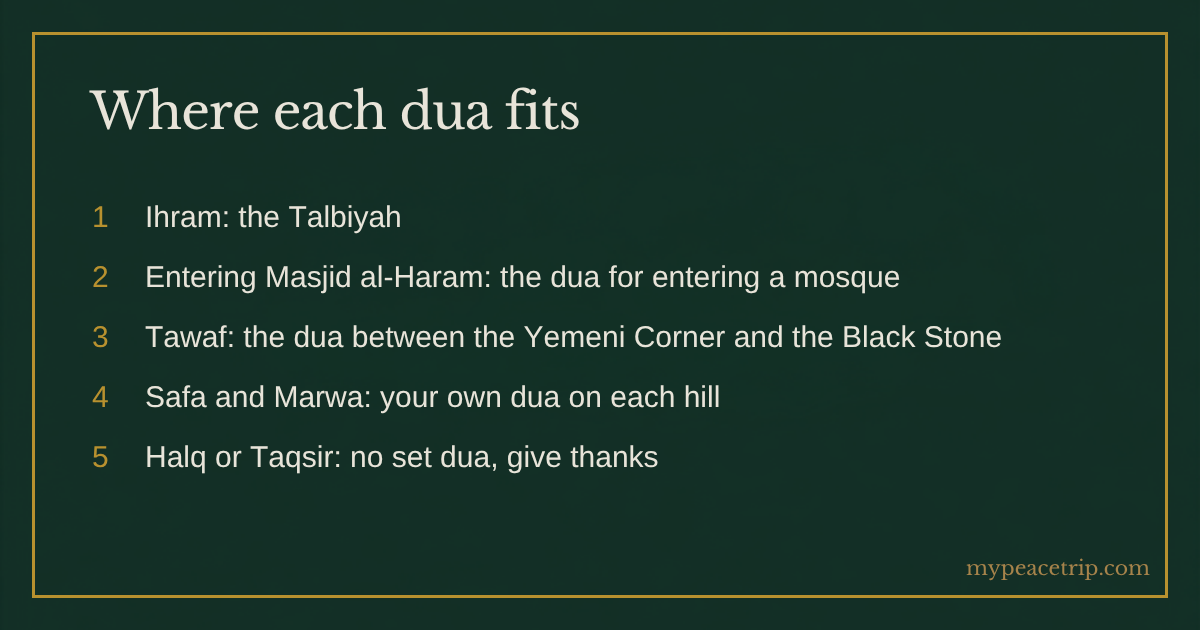
If you learn only the three fixed ones, you have everything the rites require. The rest of this guide gives you the words to reach for when your own run out.
What is the dua before starting the journey?
When the Prophet mounted his camel to set out on a journey, he said Allahu Akbar three times and then recited the verse from Surah az-Zukhruf. Ibn Umar reports it in Sahih Muslim 1342. Say it as the aircraft door closes, or as your coach pulls away.
Arabic
سُبْحَانَ الَّذِي سَخَّرَ لَنَا هَٰذَا وَمَا كُنَّا لَهُ مُقْرِنِينَ وَإِنَّا إِلَىٰ رَبِّنَا لَمُنقَلِبُونَ
Transliteration
Subhanalladhi sakhkhara lana hadha wa ma kunna lahu muqrinin, wa inna ila rabbina lamunqalibun.
Meaning
Glory be to Him who has placed this at our service, for we could never have done it ourselves, and to our Lord we shall surely return. (Quran 43:13 to 14)
The same narration continues with a longer supplication asking for righteousness and taqwa on the journey, ease in travel, and protection for the family left behind. It is worth learning, but the verse alone is the part he recited on every departure.
What is the dua for Umrah niyyah (intention)?
The intention for Umrah is made in the heart, and the words that follow it are the Talbiyah. There is no separate fixed sentence of niyyah in the hadith collections. Many pilgrims say “Labbayk Allahumma Umrah” or “Allahumma inni uridul Umrah”, meaning “O Allah, I intend Umrah”, and there is no harm in that, but understand it as a statement of intent rather than a required formula.
What the Prophet did say, loudly and repeatedly from the miqat onward, is the Talbiyah. Abdullah ibn Umar gives its exact wording in Sahih al-Bukhari 1549:
Arabic
لَبَّيْكَ اللَّهُمَّ لَبَّيْكَ، لَبَّيْكَ لاَ شَرِيكَ لَكَ لَبَّيْكَ، إِنَّ الْحَمْدَ وَالنِّعْمَةَ لَكَ وَالْمُلْكَ، لاَ شَرِيكَ لَكَ
Transliteration
Labbayk Allahumma labbayk. Labbayka la sharika laka labbayk. Innal-hamda wan-ni’mata laka wal-mulk. La sharika lak.
Meaning
Here I am, O Allah, here I am. Here I am, You have no partner, here I am. Truly all praise, grace and sovereignty are Yours. You have no partner.
Men raise their voices; women say it so that only they can hear. Keep repeating it, between conversations and on the coach, until you begin Tawaf. Jabir notes that the companions added phrases of their own to it and the Prophet did not object, so a few extra words of praise are not a fault. If you are unsure what to wear before you say it, the guides to ihram for men and ihram for women cover the clothing.
What dua do you make on seeing the Kaaba?
There is no wording for this moment in Jabir’s narration, and none in the sound collections attributed to the Prophet. The supplication printed in most booklets, “O Allah, increase this House in honour and reverence”, is reported from Umar ibn al-Khattab, not from the Prophet.
So use the moment. Many pilgrims raise their hands and ask for the single thing they came for. Keep a specific request ready, because the crowd will move you on faster than you expect.
What do you recite during Tawaf?
Tawaf is free supplication, with one verse the Prophet recited between the Yemeni corner and the Black Stone. Abdullah ibn as-Sa’ib heard him say it there, recorded in Sunan Abi Dawud 1892:
Arabic
رَبَّنَا آتِنَا فِي الدُّنْيَا حَسَنَةً وَفِي الآخِرَةِ حَسَنَةً وَقِنَا عَذَابَ النَّارِ
Transliteration
Rabbana atina fid-dunya hasanatan wa fil-akhirati hasanatan wa qina ‘adhaban-nar.
Meaning
Our Lord, give us good in this world and good in the Hereafter, and protect us from the punishment of the Fire. (Quran 2:201)
Say “Allahu Akbar” when you are level with the Black Stone at the start of each circuit. For the rest of each circuit, pray for whatever you need, in any language. The Prophet walked briskly for the first three circuits and normally for the last four (Sahih Muslim 1218a); the words are yours.
What do you say after Tawaf at Maqam Ibrahim?
After the seventh circuit the Prophet went to the Station of Ibrahim, recited one verse, and prayed two rak’ahs with the Station between himself and the Kaaba. Jabir records the verse and the two surahs he read in Sahih Muslim 1218a.
Arabic
وَاتَّخِذُوا مِن مَّقَامِ إِبْرَاهِيمَ مُصَلًّى
Transliteration
Wattakhidhu mim-maqami Ibrahima musalla.
Meaning
And take the Station of Ibrahim as a place of prayer. (Quran 2:125)
In the two rak’ahs he recited Surah al-Kafirun in the first and Surah al-Ikhlas in the second. If the space at the Station is crowded, pray anywhere in the mosque; the Station between you and the Kaaba is the sunnah, not a condition.
What is the dua at Safa and Marwa?
Two things are fixed here: a verse as you approach Safa, and a declaration on top of each hill.
As he neared Safa, the Prophet recited the verse and added one sentence explaining why he started there:
Arabic
إِنَّ الصَّفَا وَالْمَرْوَةَ مِن شَعَائِرِ اللَّهِ. أَبْدَأُ بِمَا بَدَأَ اللَّهُ بِهِ
Transliteration
Innas-Safa wal-Marwata min sha’a’irillah. Abda’u bima bada’allahu bih.
Meaning
Indeed Safa and Marwa are among the symbols of Allah. (Quran 2:158) I begin with what Allah began with.
Then he climbed Safa until he could see the Kaaba, faced it, declared Allah’s oneness and greatness, and said the following three times, making his own dua in between:
Arabic
لاَ إِلَهَ إِلاَّ اللَّهُ وَحْدَهُ لاَ شَرِيكَ لَهُ، لَهُ الْمُلْكُ وَلَهُ الْحَمْدُ وَهُوَ عَلَى كُلِّ شَيْءٍ قَدِيرٌ. لاَ إِلَهَ إِلاَّ اللَّهُ وَحْدَهُ، أَنْجَزَ وَعْدَهُ، وَنَصَرَ عَبْدَهُ، وَهَزَمَ الأَحْزَابَ وَحْدَهُ
Transliteration
La ilaha illallahu wahdahu la sharika lah, lahul-mulku wa lahul-hamdu wa huwa ‘ala kulli shay’in qadir. La ilaha illallahu wahdah, anjaza wa’dah, wa nasara ‘abdah, wa hazamal-ahzaba wahdah.
Meaning
There is no god but Allah alone, without partner. His is the dominion and His is the praise, and He has power over all things. There is no god but Allah alone. He fulfilled His promise, gave victory to His servant, and defeated the confederates alone.
He did exactly the same on Marwa. Between the hills, and in the valley where men walk faster between the green markers, the narration says only that he supplicated. Say what you need to say.
What is the dua when drinking Zamzam?
The Sahihayn record the Prophet drinking Zamzam standing, and asking for it to be drawn for him, but no fixed dua at the moment of drinking. A widely printed supplication asking for beneficial knowledge, wide provision and healing from every illness is reported from Ibn Abbas as his own practice.
The safest guidance is to drink facing the Kaaba, say Bismillah, and ask for what you came for. Drink it after Sa’i, and again whenever you pass a cooler.
What is the dua for cutting the hair?
None is required of the pilgrim. What the sound hadith gives is the Prophet’s own dua for those who shave: “O Allah, have mercy on those who shave their heads.” The companions asked him to include those who only trim, and he said the same for them on the third request, recorded in Sahih al-Bukhari 1727. That is why shaving is preferred for men. Women cut a fingertip’s length from the end of a plait.
Once the hair is cut, Umrah is complete and the restrictions of ihram end.
What dua do you make for someone going on Umrah?
There is no fixed wording, so say what you mean. The two most natural things to ask are that Allah accepts their Umrah and returns them safely, and both are captured in phrases every Arabic speaker will recognise:
- Taqabbal Allahu minkum: May Allah accept it from you.
- Umrah maqbulah, wa dhanbun maghfur: An accepted Umrah, and forgiven sins.
If you want them to carry a request on your behalf, ask directly. Companions used to ask the Prophet to remember them in his dua, and there is nothing wrong in asking a departing pilgrim to do the same for you.
Printable duas for Umrah card
Everything above, in order, fits on one side of A4. Print it, fold it into your ihram belt, and you will not need to unlock a phone inside the Haram.
| Step | Say | Ref |
|---|---|---|
| Leaving | Subhanalladhi sakhkhara lana hadha… | Muslim 1342 |
| Ihram | Labbayk Allahumma labbayk… | Bukhari 1549 |
| Seeing the Kaaba | Your own dua | (none fixed) |
| Each Tawaf circuit begins | Allahu Akbar | Muslim 1218a |
| Between the corners | Rabbana atina fid-dunya hasanah… | Abu Dawud 1892 |
| Maqam Ibrahim | Wattakhidhu mim-maqami Ibrahima musalla, then 2 rak’ahs | Muslim 1218a |
| Approaching Safa | Innas-Safa wal-Marwata min sha’a’irillah. Abda’u bima bada’allahu bih | Muslim 1218a |
| On Safa and Marwa, three times | La ilaha illallahu wahdahu la sharika lah… | Muslim 1218a |
| Zamzam | Bismillah, then your own dua | (none fixed) |
| Hair | No dua required | Bukhari 1727 |
Every package we run includes a laminated copy of these duas for Umrah in your welcome pack, along with the Umrah packing list and the step by step guide to the rites. If you are still choosing dates or hotels, the Umrah packages page has the current options.
Frequently Asked Questions
What duas should I ask in front of the Kaaba?
Whatever you came for. No wording is fixed for this moment in the Prophet’s own pilgrimage as narrated by Jabir, so there is no correct formula to memorise. Decide your request before you enter the mosque, because the first sight is brief and the crowd moves.
What is the azkar for Umrah?
The azkar with a fixed wording are the Talbiyah in ihram, Allahu Akbar at the start of each Tawaf circuit, the verse between the Yemeni corner and the Black Stone, the verse approaching Safa, and the declaration of tawhid on top of Safa and Marwa. Everything else is open supplication.
What is the dua to pray for when completing the Umrah?
None is prescribed. Umrah ends when the hair is cut, and the hadith gives no closing dua for the pilgrim. Many people thank Allah for acceptance and ask to be invited back; that is a fine thing to say, and it is your own words.
What to read when doing Safa Marwa?
As you approach Safa, recite the verse “Innas-Safa wal-Marwata min sha’a’irillah”. On top of Safa, and again on Marwa, say “La ilaha illallahu wahdahu la sharika lah…” three times, making your own dua between the repetitions. While walking between the hills, supplicate freely.