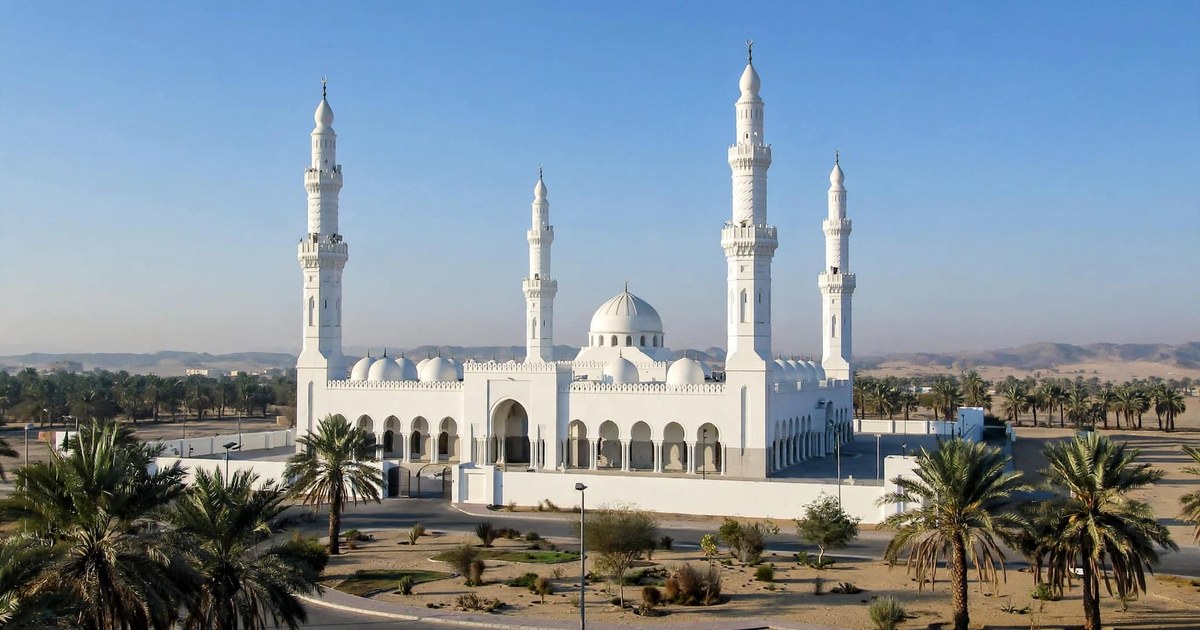
A miqat is a boundary on the way to Makkah that you must not cross without being in ihram if you intend Umrah or Hajj. There are five miqat points, and the one that applies to you depends on your route, not your nationality. Pilgrims flying into Jeddah cross their miqat in the air and enter ihram on the plane. Pilgrims who go to Madinah first enter ihram at Dhul Hulaifah, about 14 km from the Prophet’s Mosque. Pilgrims already in Makkah go out to Masjid Aisha at Tan’im.
What is a miqat?
A miqat is the place fixed by the Prophet at which anyone heading for Makkah with the intention of Umrah or Hajj must be in ihram. Ibn Abbas narrates in Sahih al-Bukhari 1524 that the Prophet fixed Dhul Hulaifah for the people of Madinah, al-Juhfah for the people of Sham, Qarn al-Manazil for the people of Najd and Yalamlam for the people of Yemen, that these boundaries also bind anyone else who passes through them intending Hajj or Umrah, and that whoever lives inside them enters ihram from where they set out, the people of Makkah from Makkah.
Two things follow. The miqat is tied to the road, so a British pilgrim who goes to Madinah first uses the Madinah miqat. And the rule is about crossing a line, not visiting a building: you are in ihram once you have made the intention, whether in the miqat mosque, on a coach or in an aircraft seat. The clothing and restrictions are in the guides to ihram for men and ihram for women; this page is about where and when.
Which are the five miqat points named in the hadith?
The four named by the Prophet are Dhul Hulaifah, al-Juhfah, Qarn al-Manazil and Yalamlam; the fifth, Dhat Irq, was fixed by Umar for the people of Iraq in line with Qarn al-Manazil (Sahih al-Bukhari 1531). Distances are from Saudipedia, the encyclopedia published by the Saudi Ministry of Media.
| Miqat | Fixed for | Direction | Distance from Makkah | Known today as |
|---|---|---|---|---|
| Dhul Hulaifah | People of Madinah and those on their road | North | About 433 km; about 14 km from the Prophet’s Mosque (Saudipedia) | Abyar Ali |
| Al-Juhfah | People of Sham, Egypt, Morocco and Africa | Northwest | About 178 km, near Rabigh (Saudipedia) | Rabigh |
| Qarn al-Manazil | People of Najd and the Gulf | Northeast | About 80 km, 35 km north of Taif (Saudipedia) | Al-Sayl al-Kabir |
| Yalamlam | People of Yemen and the south | Southwest | About 85 km on the coastal road (Saudipedia) | Al-Sa’diyyah |
| Dhat Irq | People of Iraq and the north | Northeast | About 90 km (Saudipedia) | Ad-Dharibah |
Which miqat applies to your arrival route?
Your miqat is the one your route crosses or comes in line with. The Islamweb fatwa centre, answering pilgrims from India, Pakistan and Bangladesh, states the principle for air and sea travel: the traveller enters ihram when parallel to a miqat, as on land, and slightly before it to allow for the speed of the aircraft (Islamweb fatwa 268105).
| Where you start | Your miqat | When to change and make the intention |
|---|---|---|
| UK, direct to Jeddah | The miqat the aircraft comes in line with; for approaches from the north, al-Juhfah (islamqa 41978) | Dress before boarding or at the transit airport; make the intention when the crew announce the miqat, or earlier |
| Pakistan, India or Bangladesh, to Jeddah | The miqat the flight path comes parallel to; sea arrivals come parallel to Yalamlam (Islamweb 268105) | Same as above |
| Madinah first, then Makkah by coach | Dhul Hulaifah, called Abyar Ali (Bukhari 1524) | Bathe at the hotel, arrive at the miqat mosque dressed, make the intention before the coach moves off |
| Madinah first, by Haramain train | Dhul Hulaifah | The train does not stop; dress at the hotel and make the intention at the station or as the train leaves Madinah |
| Madinah to Jeddah by air | Dhul Hulaifah | Dress in Madinah; say the Talbiyah after take-off, before the plane passes the miqat (islamqa 109293) |
| Riyadh or the Gulf, by road or air | Qarn al-Manazil, now al-Sayl al-Kabir (islamqa 4635) | At the miqat by road; on the plane when in line with it, or before |
| Already in Makkah, for another Umrah | Tan’im (Masjid Aisha) or Ji’ranah (Bukhari 1784) | Go out to the mosque, change and make the intention there |
| Living in Jeddah, or there for another reason | Jeddah itself (islamqa 4635) | From your home or hotel |
If your package goes to Madinah first, your ihram day is the day you leave Madinah, not the day you land; coach and train are compared in the Makkah to Madinah transport guide.
When do you change into ihram on a flight to Jeddah?
You must be in ihram before the aircraft comes in line with the miqat on its route, which happens in the final stretch of the flight, so dress before departure and make the intention early in the descent. The answer on islamqa states the rule and its reason: the passenger who comes in line with the miqat must enter ihram, and it is better to do so beforehand because of the speed of the aircraft (islamqa 132269). A second answer, islamqa 4635, linked below, puts it as entering ihram when in line with the miqat “or, to be on the safe side, before they reach it”.
That mechanism removes the two common mistakes. The first is waiting for the announcement. Airlines into Jeddah usually announce the miqat, but the announcement is a courtesy, not the trigger: the ruling above was given to a crew member who forgot it, and it holds the crew member responsible while still requiring every passenger who passed the miqat without ihram to offer a sacrifice. The second is trying to change in an aircraft toilet during descent with the seatbelt sign on. Men should board in the two sheets or change at the last transit airport; women need only ordinary modest clothing. Ask the crew after boarding when they expect the miqat, and if the answer is vague, treat the start of the descent as your deadline. Entering ihram early is valid; entering it late carries a penalty.
Where is the miqat from Madinah to Makkah?
The miqat from Madinah to Makkah is Dhul Hulaifah, known locally as Abyar Ali, about 14 km from the Prophet’s Mosque on the road south, as the Saudipedia entry linked in the table above records. It is the miqat fixed for the people of Madinah in Sahih al-Bukhari 1524 and the one the Prophet used himself, as the guide to how to perform Umrah explains.
Coaches stop long enough to pray two rak’ahs and make the intention, not long enough to shower in a crowd, so bathe at the hotel before checkout and arrive dressed. The Haramain train does not stop and passes the miqat within minutes of leaving Madinah, so dress at the hotel and make the intention on the platform.
Is Jeddah a miqat point?
No. Jeddah is not a miqat for anyone arriving from abroad with the intention of Umrah, because every route into Jeddah crosses or comes in line with one of the five first. The islamqa ruling is explicit: Jeddah is not a miqat for Hajj or Umrah except for its own citizens and residents, and for people who came to Jeddah for another reason and only then decided to perform Umrah (islamqa 4635).
Some agents still tell pilgrims to land in ordinary clothes, rest in Jeddah and enter ihram from the hotel. Shaykh Ibn Baz’s answer, islamqa 36646, cited in the section on missing the miqat below, addresses exactly that advice and rejects it.
Is Masjid Aisha a miqat point?
Yes, for people already inside the Haram boundary who want to perform Umrah. Masjid Aisha at Tan’im is the nearest point outside the sacred precinct, and the Prophet sent Aisha there with her brother Abdur-Rahman to enter ihram for Umrah (Sahih al-Bukhari 1784). It is not a miqat for anyone arriving from outside; those pilgrims have already crossed one of the five.
Ji’ranah, northeast of Makkah, serves the same purpose: Anas records that the Prophet performed one of his four Umrahs from there after Hunain (Sahih al-Bukhari 1778). In practice almost everyone uses Tan’im: taxis wait outside the Haram and the round trip takes under an hour outside peak times.
What happens if you pass the miqat without ihram?
You go back to the miqat and enter ihram there; if you cannot, you enter ihram where you are and owe a sacrifice, slaughtered in Makkah and given to its poor (islamqa 36646). The sacrifice applies whether the omission was deliberate or careless, and the crew-member case cited above shows it applies even when the omission was someone else’s. Going back is the better course whenever possible, and from Jeddah it is possible: Rabigh and al-Sayl al-Kabir are both within a few hours’ drive.
Ready to go?
Our Umrah packages are built around the miqat your route crosses. If your itinerary starts in Madinah, the coach stops at Abyar Ali and the guide walks you through the intention there; if you fly straight to Jeddah, the pre-departure briefing covers what to wear on the plane and when to say the Talbiyah. A reader in Pakistan sees the package price in rupees automatically.
Which miqat you cross depends on how you arrive, so the airport matters. Our guide to flights for Umrah from the UK explains why flying into Jeddah means changing into ihram on the aircraft and flying into Madinah does not.
Frequently Asked Questions
Which Miqat is for Pakistan?
Pilgrims flying from Pakistan to Jeddah enter ihram when the aircraft comes parallel to the miqat on its flight path, or shortly before it to allow for the speed of the aircraft, and sea arrivals come parallel to Yalamlam, according to the Islamweb fatwa centre. No miqat is assigned to Pakistan as a country; a Pakistani pilgrim who goes to Madinah first uses Dhul Hulaifah.
Is Jurana Miqat?
Ji’ranah is not one of the five miqat points fixed for people arriving from outside, but it is a valid place for someone already in Makkah to go out and enter ihram for Umrah. Anas narrates in Sahih al-Bukhari 1778 that the Prophet performed one of his Umrahs from Ji’ranah after the battle of Hunain. It lies northeast of Makkah and is used far less often than Tan’im.
Can you enter ihram before reaching the miqat?
Yes. Entering ihram before the miqat is valid, and the fatwa bodies recommend it for air passengers because the aircraft passes the line in seconds. Many pilgrims make the intention at the departure airport or soon after take-off. What is not permitted is crossing the miqat towards Makkah while not yet in ihram.
Do residents of Jeddah have a miqat?
Residents of Jeddah enter ihram from Jeddah itself, because they live inside the boundary of the five miqat points and Sahih al-Bukhari 1524 states that whoever lives within the boundaries enters ihram from where they set out. The same applies to a visitor who came to Jeddah for another purpose and later decided to perform Umrah.
How far is Dhul Hulaifah from Madinah and Makkah?
Dhul Hulaifah, known locally as Abyar Ali, is about 14 km from the Prophet’s Mosque in Madinah and about 433 km from the Grand Mosque in Makkah, according to Saudipedia. Its mosque holds around 7,000 worshippers and is the standard stop for coaches leaving Madinah, where pilgrims pray two rak’ahs and make the intention for Umrah.