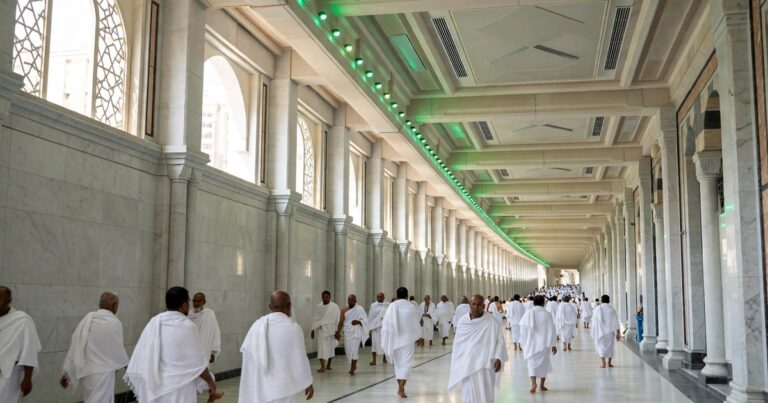
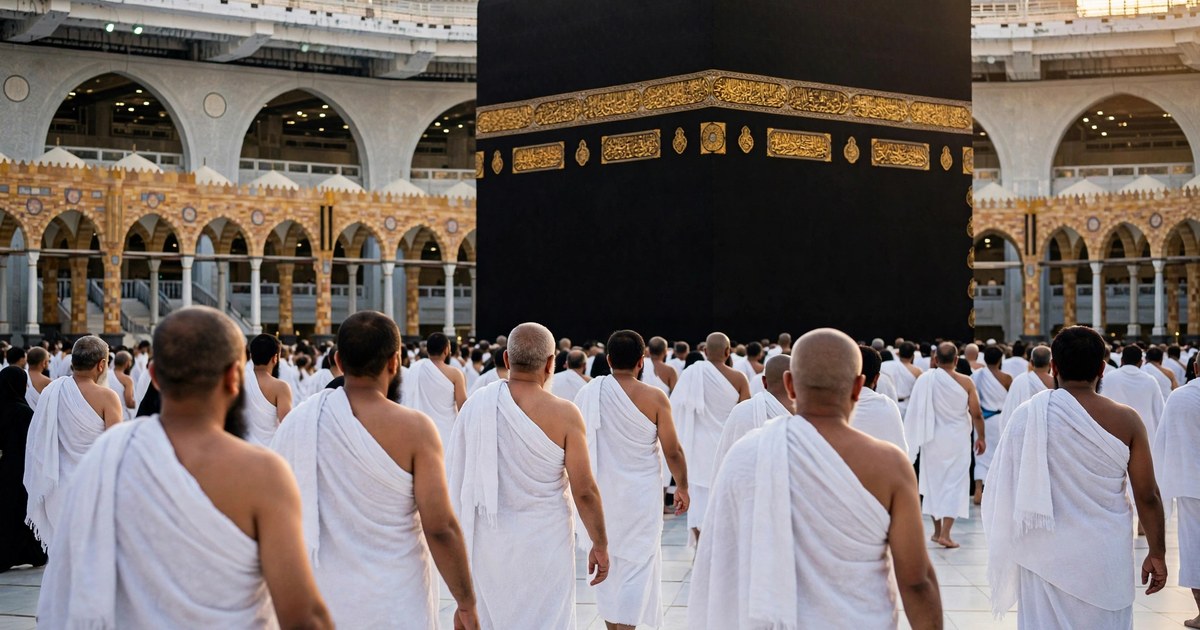
Tawaf is the act of walking around the Kaaba seven times, anticlockwise, with the Kaaba on your left, beginning and ending in line with the Black Stone. It is a pillar of Umrah, without which the Umrah is not valid, and a pillar of Hajj in the form of Tawaf al-Ifadah. It requires wudu according to most scholars, it must be performed inside Masjid al-Haram, and on an ordinary day it takes about 42 minutes.
The word comes from the Arabic root meaning to go around something; the paved area around the Kaaba is the Mataf, the place of Tawaf, and in religious usage the word is reserved for circling the Kaaba as worship. The full sequence of the rites is in our guide to how to perform Umrah.
Why do we do 7 rounds of Tawaf?
Seven rounds because that is what the Prophet did; the number is not explained further in the texts. Jabir ibn Abdullah describes him touching the corner of the Black Stone and making seven circuits, walking briskly for three and at a normal pace for four, in Sahih Muslim 1218a. Every kind of Tawaf is seven circuits followed by two rak’ahs.
The brisk walk in the first three circuits, called raml, has a recorded reason: the pagans had spread word that the fever of Madinah had weakened the Muslims, so the Prophet ordered raml for three circuits and spared them the rest out of pity, as Ibn Abbas reports in Sahih al-Bukhari 1602. Raml is for men, in the first Tawaf on arrival, and only when there is room.
What are the five kinds of Tawaf?
There are five kinds in common use: the Tawaf of Umrah, Tawaf al-Qudum on arriving for Hajj, Tawaf al-Ifadah after Arafah, Tawaf al-Wada on leaving Makkah, and voluntary Tawaf, plus the Tawaf of a vow. Their timing and status, as set out on Islam Question and Answer, are in the table.
| Kind of Tawaf | When it is performed | Status |
|---|---|---|
| Tawaf of Umrah | On entering Makkah in ihram for Umrah, before Sa’i | Pillar of Umrah; Umrah is not valid without it |
| Tawaf al-Qudum (arrival) | On first reaching the Kaaba during Hajj | Obligatory duty or sunnah of Hajj; scholars differ |
| Tawaf al-Ifadah | After standing at Arafah, on the day of Eid al-Adha or after it | Pillar of Hajj |
| Tawaf al-Wada (farewell) | After the rites of Hajj, when you have decided to leave Makkah | Obligatory for Hajj on the stronger view, except for women who are menstruating or bleeding after childbirth |
| Tawaf of a vow | Whenever a person has vowed to perform one | Obligatory because of the vow |
| Voluntary Tawaf | Any time, as often as you like | Recommended worship |
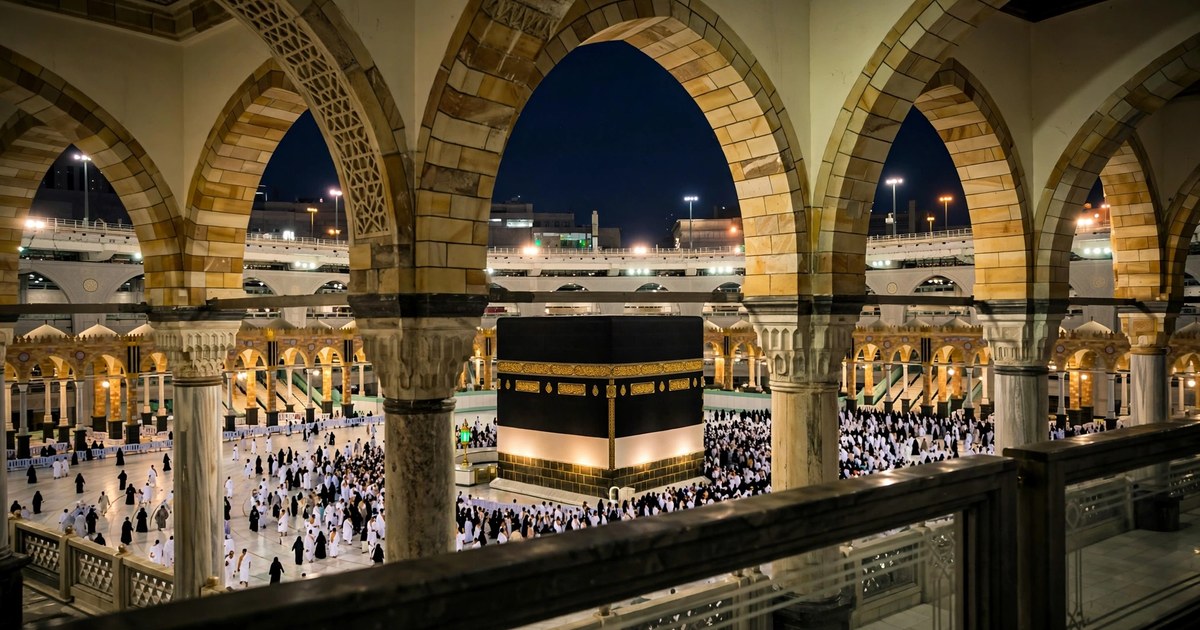
Two points from that table catch pilgrims out. Tawaf al-Ifadah is performed on the Day of Nahr, as Aisha reports in Sahih al-Bukhari 1733, and no pilgrim is excused from it; a woman who cannot perform it because of her period waits until she can. Tawaf al-Wada belongs to Hajj: the Standing Committee for Academic Research and Issuing Fatwas ruled that a person performing Umrah does not have to do the farewell Tawaf, though it is recommended.
What makes a Tawaf valid?
A valid Tawaf needs intention, purity, covered awrah, seven complete circuits inside Masjid al-Haram with the Kaaba on your left, each starting from the Black Stone, going around the outside of the Hijr, and performed consecutively. That is the list set out on Islam Question and Answer, which also notes that the majority require Tawaf on foot if you are able, while the Shafi’is allow riding.
The purity condition rests on the Prophet’s practice: when Aisha’s period began on the way to Makkah he told her to do everything the pilgrims do except Tawaf until she was clean, in Sahih al-Bukhari 305. Menstruation delays Tawaf; it does not cancel the Umrah.
A circuit that cuts through the Hijr, the low semicircular wall beside the Kaaba, has not gone around the whole Kaaba and does not count. The two rak’ahs after Tawaf, behind Maqam Ibrahim, are a sunnah rather than a condition, and the dua between the Yemeni corner and the Black Stone is in our duas for Umrah guide.
What if wudu breaks during Tawaf?
If your wudu breaks during Tawaf, the majority position is that you leave and make wudu; Malikis and Hanbalis then begin the Tawaf again, Hanafis and Shafi’is resume from where they stopped, and outside peak crowds restarting is the safest course. Islam Question and Answer sets out that view alongside Ibn Taymiyah’s view that purity is not a condition of Tawaf, and notes that in the crowding of Hajj, forcing people to leave, wash and restart repeatedly creates great hardship without clear textual basis.
The operational advice is simpler: make wudu immediately before entering the Mataf, not at the hotel, because the toilets are under the courtyards and a broken wudu mid-Tawaf costs half an hour at best.
Can you wear slippers during Tawaf?
Yes, you can perform Tawaf in clean slippers or sandals; most pilgrims are barefoot by habit, not because footwear is forbidden. Islam Question and Answer states that it is permissible to perform Tawaf wearing shoes if they are clean, and preferable not to, so that people who are careless about impurity do not copy you. Anyone with a foot injury has good reason to wear them. Men in ihram keep the separate rule on footwear, nothing that covers the ankle, in our guide to ihram for men.
How many km is 1 Tawaf?
One circuit of Tawaf is roughly 70 to 120 metres on the innermost rings by the Kaaba, 200 to 400 metres on the outer ground-floor rings, and well over half a kilometre on the upper floors and roof. These are our own paced estimates, not official measurements; we have not found published per-level figures.
| Level of the Mataf | One circuit, our estimate | Seven circuits | Who uses it |
|---|---|---|---|
| Ground floor, inner rings | 70 to 120 m | 0.5 to 0.85 km | Umrah performers |
| Ground floor, outer rings | 200 to 400 m | 1.4 to 2.8 km | Umrah performers at busy times |
| First floor and mezzanines | 500 to 700 m | 3.5 to 4.9 km | Voluntary Tawaf, wheelchairs, overflow |
| Roof | 700 to 900 m | 4.9 to 6.3 km | Peak-season overflow |
The General Authority for the Care of the Two Holy Mosques names the Tawaf levels as the ground floor, first floor, first mezzanine, second mezzanine and rooftop, with the whole Mataf able to take 107,000 people an hour. In March 2026 the Ministry of Hajj and Umrah stated that the ground floor of the Mataf is designated for Umrah performers, with Tawaf on the upper floors subject to capacity. The Ministry FAQ adds that Tawaf without an Umrah permit is allowed on the first floor.
The Prophet performed Tawaf riding a camel during his Farewell Hajj, pointing at the Black Stone with a stick, as Ibn Abbas reports in Sahih al-Bukhari 1607, so a Tawaf in a chair is a Tawaf.
How long does it take to do 7 Tawaf?
Seven circuits take about 42 minutes on an average day, by the General Authority’s own count. Its statistics for Rabi al-Thani 1447 (October 2025), published by the Saudi Press Agency, give an average Tawaf of 42 minutes, an average Sa’i of 46 minutes, 15 minutes from the courtyards to the Mataf, and a whole Umrah of 116 minutes, with 92 percent of pilgrims using the main Mataf.
In our groups’ experience the range is much wider: after Isha on a weekday outside Ramadan, seven circuits on the inner rings can be done in 25 minutes; in the last ten nights of Ramadan the same circuits on the outer ring take two hours. Plan Tawaf for the quiet windows, after Isha and between Fajr and sunrise. The trip as a whole is covered in our guide to how long Umrah takes.
Our Umrah packages put you in a hotel within walking distance of the Haram so that you can choose the quiet hours for Tawaf, and prices show in your own currency: pounds for readers in the UK, rupees for readers in Pakistan.
Frequently Asked Questions
What is the difference between Umrah and Tawaf?
Umrah is the whole minor pilgrimage: ihram at the miqat, Tawaf, two rak’ahs, Sa’i between Safa and Marwa, and cutting the hair. Tawaf is one of those rites, and it can also be performed on its own as voluntary worship without ihram. Every Umrah contains a Tawaf, but not every Tawaf is part of an Umrah.
Do you do Tawaf barefoot?
Most pilgrims do, but it is not required. Islam Question and Answer states that Tawaf in clean shoes is permissible and that going without is preferable so that careless people do not copy the habit. The Mataf marble is kept cool and clean, so barefoot is comfortable; on the hot outer rings in summer, clean sandals are sensible.
When is Tawaf al-Ifadah performed?
Tawaf al-Ifadah is performed after standing at Arafah, on the Day of Nahr, the tenth of Dhul Hijjah, or on the days after it. Aisha reports in Sahih al-Bukhari 1733 that the Prophet’s party performed it on the Day of Nahr. It is a pillar of Hajj, so a pilgrim who cannot perform it on the day performs it before leaving Makkah.
Can you use your phone during Tawaf?
Nothing in the rules of Tawaf forbids carrying a phone, and many pilgrims use one to count circuits or read dua. Talking during Tawaf is permitted; the hadith quoted on Islam Question and Answer (answer 34695) describes Tawaf as a kind of prayer except that you may speak. What causes trouble is stopping in the flow to film.
Can you do Tawaf without an Umrah permit?
Yes, on the first floor. The Ministry of Hajj and Umrah FAQ states that Tawaf without a permit is allowed on the first floor, while the ground floor of the Mataf is designated for Umrah performers with a valid Nusuk permit. Praying anywhere in Masjid al-Haram needs no permit, so a voluntary Tawaf on your last evening means taking the escalator up.